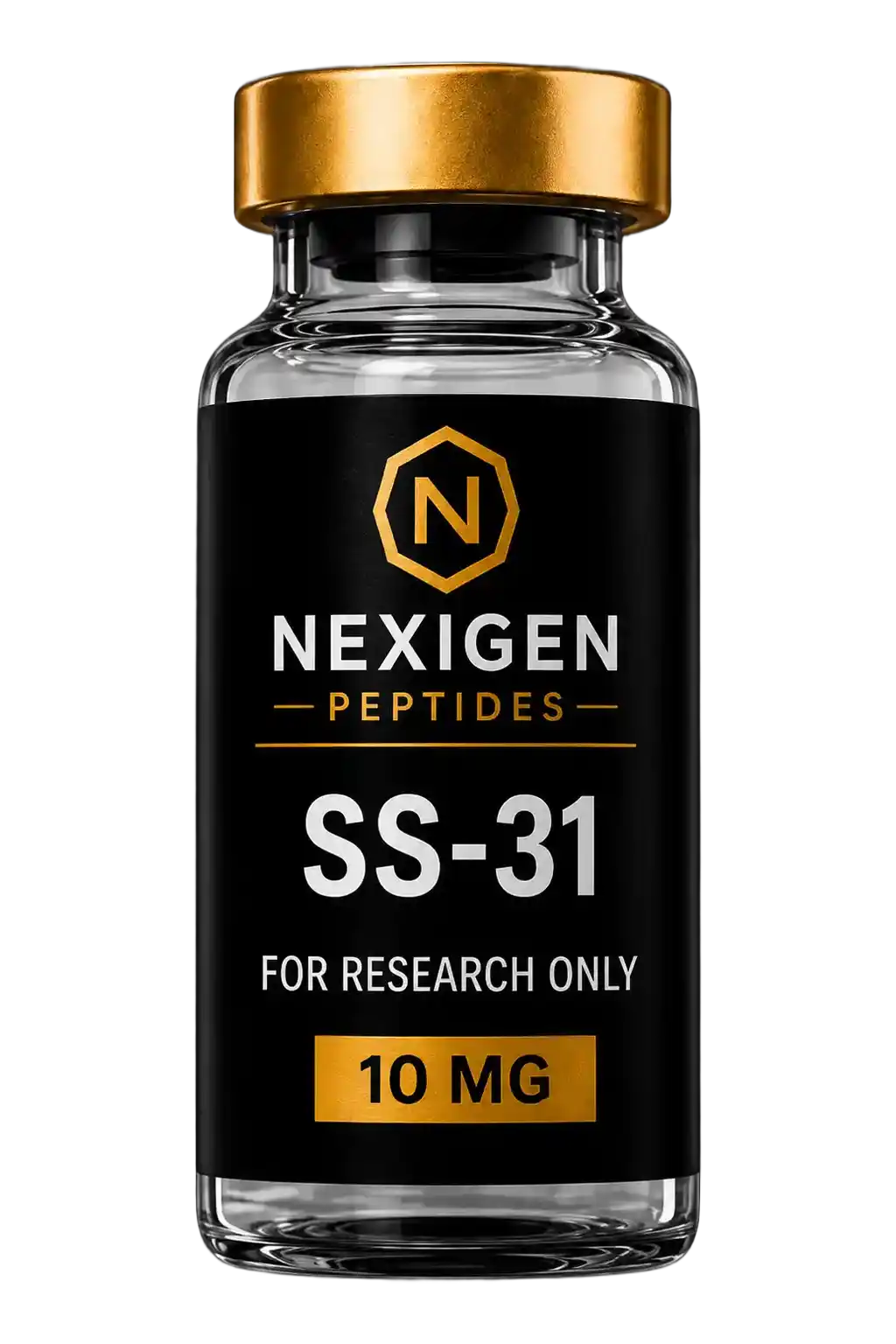
Quick answer: SS-31 10 mg Research Material is presented by Nexigen as a research peptide for legitimate laboratory, analytical and scientific research. This page provides product-specific research context and links to related Nexigen research resources.
Research Peptides hub · Research guide · Related SS-31 research
SS-31 Research Material — Product Overview
SS-31 is a synthetic tetrapeptide investigated in mitochondrial and membrane-associated laboratory research.
The compound is also identified in scientific and regulatory literature as elamipretide, and earlier research literature may refer to it as MTP-131 or Bendavia.
SS-31 contains four amino-acid-related residues, including a non-standard dimethyltyrosine residue. Its molecular structure has been investigated in research involving interactions with cardiolipin, a phospholipid concentrated within the inner mitochondrial membrane.
Nexigen SS-31 10 mg is supplied exclusively as a laboratory research material for analytical and scientific investigation.
FOR LABORATORY RESEARCH ONLY. NOT FOR HUMAN OR VETERINARY USE OR CONSUMPTION.
SS-31 10 mg — Research Specifications
| Specification | Information |
|---|---|
| Compound | SS-31 |
| Scientific Name | Elamipretide |
| Research Synonyms | MTP-131; Bendavia |
| Quantity | 10 mg |
| Compound Type | Synthetic tetrapeptide |
| Sequence / Structural Representation | H-D-Arg-Tyr(2,6-diMe)-Lys-Phe-NH2 |
| PubChem Sequence | RXKF |
| CAS Number | 736992-21-5 |
| PubChem CID | 11764719 |
| Molecular Formula | C32H49N9O5 |
| Molecular Weight | Approximately 639.8 g/mol |
| Material Form | Verify against current product documentation |
| Intended Use | Laboratory research only |
SS-31 Material Form and Analytical Identity
SS-31 is commonly identified in scientific literature as elamipretide, but the peptide may be represented in different associated chemical forms. For analytical purposes, the parent peptide and salt- or counterion-associated materials should not automatically be treated as interchangeable molecular representations.
Why material form matters: CAS number, molecular formula, expected molecular mass and analytical interpretation should correspond to the actual material form represented in the material being evaluated.
Public chemical databases separately represent parent elamipretide and salt- or counterion-associated elamipretide materials. Researchers should therefore verify material form before interpreting molecular-weight or mass-spectrometric information.
What Is SS-31?
SS-31 is a synthetic tetrapeptide also known as elamipretide and MTP-131 that has been investigated extensively in research involving mitochondrial membranes, cardiolipin and mitochondrial bioenergetics.
The peptide belongs to the class historically described as Szeto-Schiller peptides, or SS peptides.
A major area of scientific investigation involves the interaction of SS-31 with cardiolipin, a specialized phospholipid concentrated within the inner mitochondrial membrane.
SS-31, Elamipretide and MTP-131: Are They the Same Compound?
Scientific literature has used several names for the underlying SS-31 peptide.
SS-31
SS-31 is the research name commonly associated with the peptide’s early development and the Szeto-Schiller peptide class.
MTP-131
MTP-131 is another research-development identifier that appears in scientific publications involving the compound.
Elamipretide
Elamipretide is the recognized generic name associated with the compound. Elamipretide, SS-31, MTP-131 and Bendavia are names associated with the same underlying peptide identity in scientific literature when used in the appropriate context.
SS-31 Sequence and Molecular Structure
SS-31 is a compact modified tetrapeptide represented as H-D-Arg-Tyr(2,6-diMe)-Lys-Phe-NH2.
The structure contains a D-arginine residue, a modified 2,6-dimethyltyrosine residue, lysine and phenylalanine, together with C-terminal amidation. PubChem also provides the biological sequence shorthand RXKF.
SS-31 and Cardiolipin
A central theme in SS-31 research is its interaction with cardiolipin, a specialized phospholipid concentrated within the inner mitochondrial membrane.
Cardiolipin contributes to mitochondrial membrane architecture and interacts with proteins involved in oxidative phosphorylation, membrane organization and mitochondrial bioenergetics.
Inner Mitochondrial Membrane
SS-31 has been studied extensively in experimental systems involving the inner mitochondrial membrane and cardiolipin-rich membrane environments.
Membrane Electrostatics
Biophysical research has examined how SS-31 partitions into membrane interfacial regions according to membrane composition and surface charge.
Cardiolipin-Dependent Protein Organization
Modern SS-31 research increasingly examines how peptide-cardiolipin interactions may influence cardiolipin-dependent protein organization, respiratory complexes and other components of mitochondrial membrane systems.
Current Scientific and Regulatory Context
Elamipretide is no longer solely an investigational research entity.
On September 19, 2025, the U.S. Food and Drug Administration granted accelerated approval to Forzinity (elamipretide) to improve muscle strength in adult and pediatric patients with Barth syndrome weighing at least 30 kg.
The approval applies specifically to the regulated Forzinity pharmaceutical product and its FDA-approved indication. Nexigen SS-31 research material is not Forzinity and is not represented as an FDA-approved pharmaceutical product.
SS-31 Research Context
SS-31 has been investigated extensively in experimental research involving mitochondrial membranes, cardiolipin and mitochondrial bioenergetics. Research findings depend upon the experimental model, methodology, material form, sample preparation and conditions used.
Cardiolipin-Associated Research
Research has characterized SS-31 in cardiolipin-containing membrane systems and examined physicochemical interactions at the peptide-membrane interface.
Mitochondrial Membrane Research
Laboratory and preclinical studies have used SS-31 as an experimental tool for investigating mitochondrial membrane organization, mitochondrial cristae and related biochemical processes.
Bioenergetic Research
SS-31 has also appeared in experimental literature involving mitochondrial bioenergetics, oxidative phosphorylation and cellular-energy systems.
How Is SS-31 Research Material Evaluated?
Different analytical techniques answer different questions about a synthetic peptide research material.
HPLC
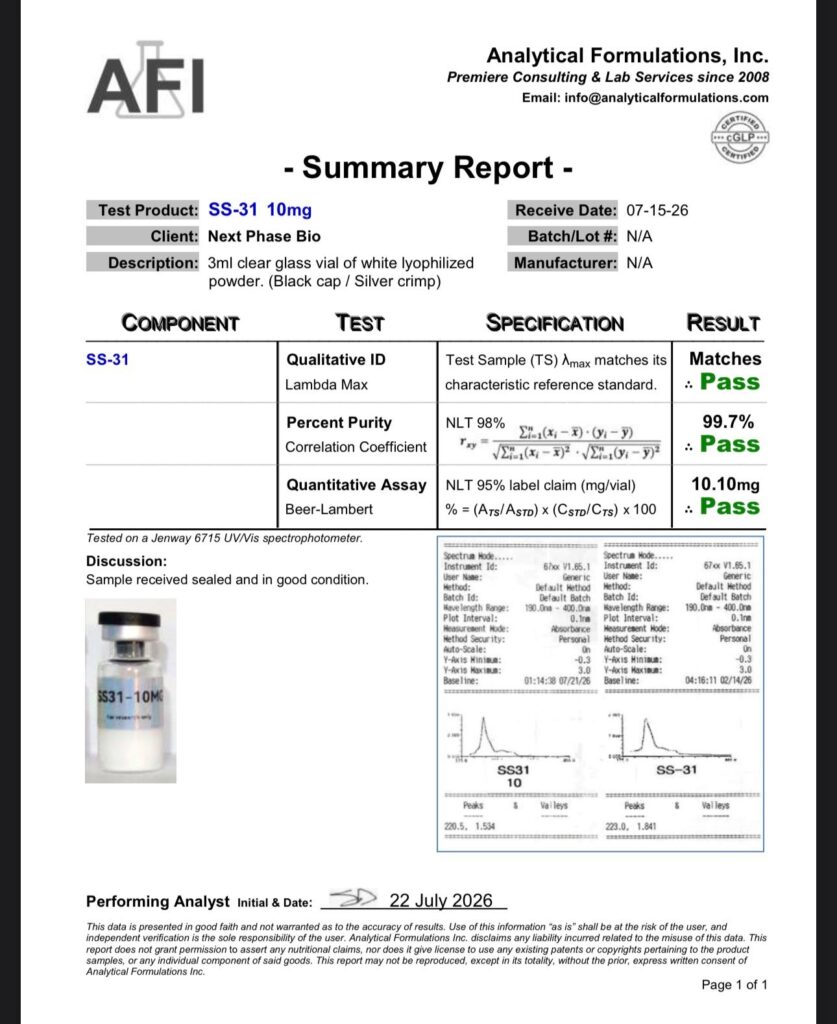
High-performance liquid chromatography can be used to separate components within a peptide sample and evaluate chromatographic composition under defined analytical conditions.
LC-MS
Liquid chromatography-mass spectrometry combines chromatographic separation with molecular mass-related information. For a defined synthetic peptide such as SS-31, LC-MS can provide complementary evidence when evaluating molecular identity and structurally related species.
Mass Spectrometry
Mass spectrometry can provide molecular information useful for evaluating whether detected material is consistent with the expected SS-31/elamipretide structure.
Sequence-Related Characterization
Because SS-31 contains a D-arginine residue, a modified 2,6-dimethyltyrosine residue and defined C-terminal structure, researchers should ensure that identity information corresponds to the material being evaluated.
Orthogonal Analysis
Where chromatographic and identity-related methods are both available, the methods can provide complementary information about the same research material.
Laboratory Handling
Handling and preparation requirements depend upon the experimental design, analytical methodology and laboratory protocol. Researchers should follow validated laboratory procedures and applicable scientific literature when preparing or handling SS-31 research material.
Nexigen Peptides does not provide human or veterinary preparation, dosing, injection or administration instructions.
Storage of SS-31 Research Material
Store the material according to the conditions specified in applicable product documentation. Laboratory personnel should use appropriate procedures to minimize unnecessary exposure to moisture, light, temperature fluctuations or other environmental conditions that could affect research-material integrity.
Current SS-31 and Elamipretide Research
SS-31/elamipretide has progressed from primarily experimental mitochondrial research into both advanced clinical investigation and an FDA-approved pharmaceutical context.
Recent scientific literature continues to examine the structure, cardiolipin interaction, membrane behavior, mitochondrial targeting and experimental history of elamipretide across a range of research systems.
SS-31 Research Resources
What Is SS-31?
A scientific introduction to SS-31, elamipretide, MTP-131, cardiolipin and mitochondrial membrane research.
SS-31 Sequence, Structure and Molecular Characteristics
Explore the modified tetrapeptide structure, sequence representation, molecular formula, molecular weight, stereochemical characteristics and material-form considerations.
SS-31 Research in 2026
Review current scientific research involving elamipretide, cardiolipin, mitochondrial membranes and recent scientific and regulatory developments.
SS-31 Analytical Testing
Learn how HPLC, LC-MS, mass spectrometry and complementary analytical methods can be used to evaluate SS-31 research material.
Selected SS-31 Research References
First-in-Class Cardiolipin-Protective Compound and Mitochondrial Bioenergetics
Elamipretide: Structure, Mechanism and Research Development
PubChem Molecular Record for Elamipretide
SS-31 Research FAQ
What is SS-31?
SS-31 is a synthetic tetrapeptide investigated extensively in research involving mitochondrial membranes, cardiolipin and associated molecular interactions.
Is SS-31 the same as elamipretide?
Yes. SS-31 is commonly identified as elamipretide and has also appeared in scientific literature under development names including MTP-131 and Bendavia.
What is the SS-31 sequence?
The condensed structural representation is H-D-Arg-Tyr(2,6-diMe)-Lys-Phe-NH2. PubChem also provides the biological-sequence shorthand RXKF.
What is the CAS number for SS-31?
The CAS number associated with parent elamipretide is 736992-21-5.
What is the PubChem CID for elamipretide?
The PubChem Compound ID for parent elamipretide is 11764719.
What is the molecular formula of SS-31?
The molecular formula for parent elamipretide is C32H49N9O5.
What is the molecular weight of SS-31?
PubChem lists the molecular weight of parent elamipretide as approximately 639.8 g/mol. Researchers should verify the actual material form because salt- or counterion-associated forms may have different represented molecular weights.
What is cardiolipin?
Cardiolipin is a specialized phospholipid concentrated within the inner mitochondrial membrane and is an important subject of SS-31 research.
Is elamipretide an FDA-approved drug?
Yes. FDA granted accelerated approval to Forzinity (elamipretide) in September 2025 for a specific Barth syndrome indication. Nexigen SS-31 research material is not represented as the FDA-approved Forzinity pharmaceutical product.
Does Nexigen provide SS-31 dosing or administration instructions?
No. Nexigen Peptides does not provide human or veterinary dosing, injection, administration or treatment instructions.
Research Use Only
Nexigen SS-31 10 mg is supplied exclusively for legitimate laboratory, analytical and scientific research.
This material is not represented as Forzinity or as an FDA-approved pharmaceutical product and is not intended for human or veterinary use or consumption.
Nexigen Peptides does not provide medical advice, human or personal-use guidance.
SS-31 Research at a Glance
Quick Answer
SS-31 10 mg Research Material is presented by Nexigen as a research peptide for legitimate laboratory, analytical and scientific research.
Key Facts
- Research material: SS-31
- Page type: Product-specific research material page
- Related research resources: 6
- Aliases/search terms: ss 31, ss31, elamipretide, mtp 131
Evidence Interpretation
Research findings linked from this page may come from biochemical, cellular, animal or human studies depending on the compound. Those evidence levels answer different questions and should not be treated as interchangeable.
What This Page Does Not Establish
This page does not establish human or veterinary safety, efficacy, dosing, administration or a clinical indication. Nexigen does not provide personal-use guidance.