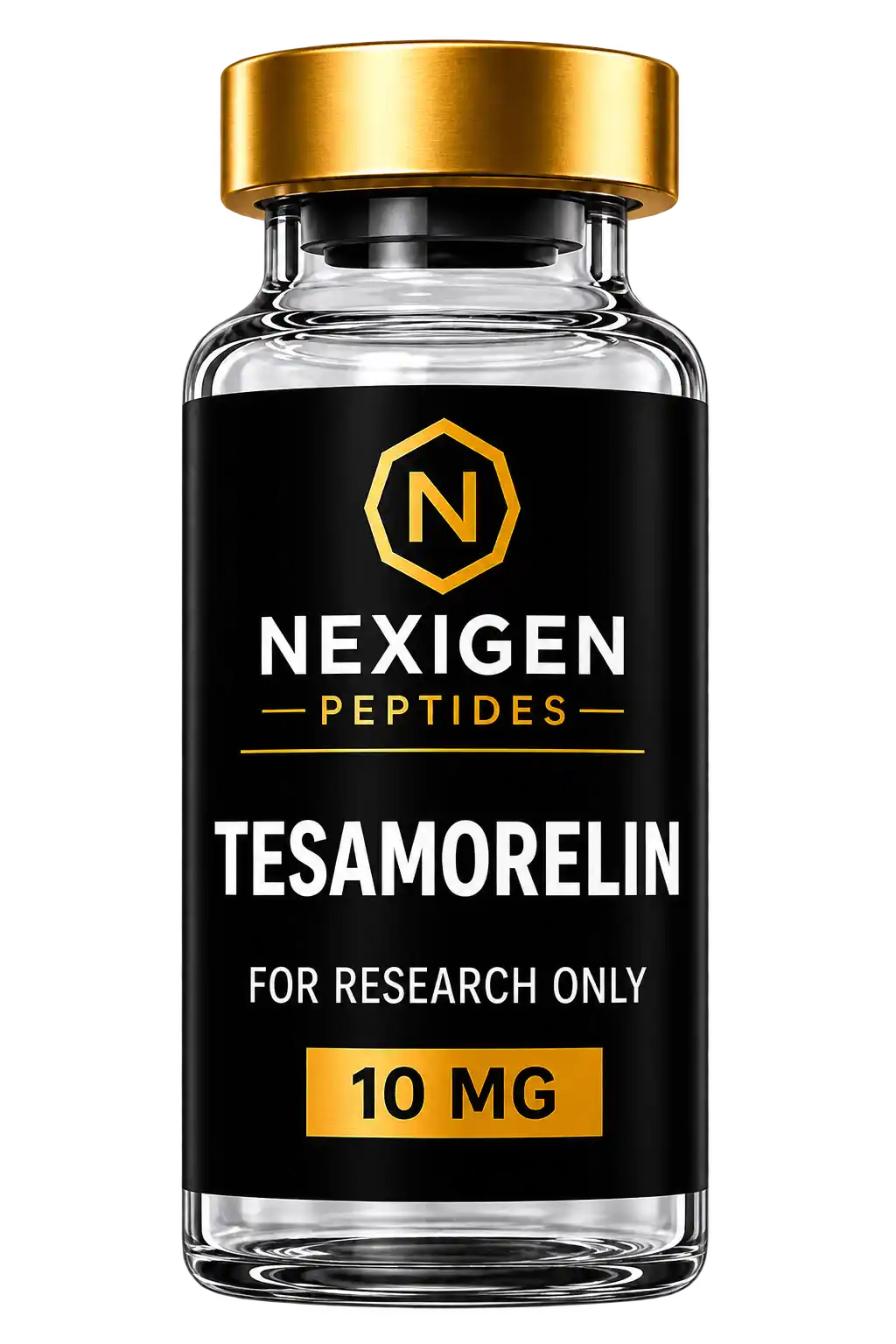
Quick answer: Tesamorelin 10 mg Research Material is presented by Nexigen as a research peptide for legitimate laboratory, analytical and scientific research. This page provides product-specific research context and links to related Nexigen research resources.
Research Peptides hub · Research guide · Related Tesamorelin research
Tesamorelin Research Material — Product Overview
Tesamorelin is a synthetic peptide analog of human growth hormone-releasing hormone, commonly abbreviated GHRH.
GHRH is a peptide signaling molecule studied for its interaction with the growth hormone-releasing hormone receptor (GHRH-R), a G-protein-coupled receptor involved in endocrine signaling.
Tesamorelin is structurally related to human GHRH and incorporates an N-terminal modification designed to distinguish the synthetic analog from the naturally occurring peptide.
Nexigen Tesamorelin 10 mg is supplied exclusively as a laboratory research material for analytical and scientific investigation.
The information on this page is provided to identify the material, summarize relevant scientific research context and provide access to available product information.
This material is intended strictly for laboratory research and is not intended for human or veterinary use or consumption.
Tesamorelin 10 mg — Research Specifications
| Specification | Information |
|---|---|
| Compound | Tesamorelin |
| Quantity | 10 mg |
| Compound Type | Synthetic GHRH analog peptide |
| Sequence Length | 44 residues |
| Amino-Acid Sequence | YADAIFTNSYRKVLGQLSARKLLQDIMSRQQGESNQERGARARL |
| CAS Number | 218949-48-5 |
| PubChem CID | 16137828 |
| Molecular Formula | C221H366N72O67S |
| Molecular Weight | Approximately 5136 g/mol |
| Research Identifier | TH9507 |
| N-Terminal Modification | trans-3-hexenoyl |
| Material Form | Verify against current Nexigen lot documentation |
| Lot / Batch | Refer to current research information |
| Analytical Method | Refer to current research information |
| Reported Result | Refer to current research information |
| Intended Use | Laboratory research only |
Tesamorelin is identified as CAS 218949-48-5, molecular formula C221H366N72O67S, molecular weight approximately 5136 g/mol, and is also associated with the research identifier TH9507.
The exact chemical specifications of Nexigen Tesamorelin should correspond to the material form identified in the applicable current research information.
What Is Tesamorelin?
Tesamorelin is a synthetic 44-residue peptide analog of human growth hormone-releasing hormone used in research involving GHRH receptor signaling and related endocrine pathways.
Human GHRH interacts with the growth hormone-releasing hormone receptor, or GHRH-R.
GHRH-R belongs to the family of G-protein-coupled receptors, commonly abbreviated GPCRs.
Research into GHRH receptor biology continues to investigate GHRH-R signaling, receptor regulation and GHRH analogs across multiple experimental systems.
Tesamorelin has historically appeared in both research and pharmaceutical-development literature under the identifier TH9507.
Nexigen supplies Tesamorelin exclusively as a laboratory research material.
Tesamorelin vs. Tesamorelin Acetate
Tesamorelin and tesamorelin acetate contain the same tesamorelin peptide moiety,
but they are represented as different chemical forms.
Why this distinction matters:
CAS number, molecular formula, molecular weight and analytical documentation
should correspond to the actual material form associated with the specific
production lot.
| Specification | Tesamorelin | Tesamorelin Acetate |
|---|---|---|
| Peptide Moiety | Tesamorelin | Tesamorelin |
| CAS Number | 218949-48-5 | 901758-09-6 |
| Approximate Molecular Weight | 5136 g/mol | 5196 g/mol |
| Material Representation | Tesamorelin | Acetate-associated tesamorelin form |
PubChem identifies tesamorelin as CAS 218949-48-5 with a
molecular weight of approximately 5136 g/mol.
Tesamorelin acetate is separately represented as CAS
901758-09-6 with a molecular weight of approximately
5196 g/mol.
Researchers should therefore verify that CAS, formula, molecular-weight
information and analytical documentation correspond to the
actual material form associated with the specific production lot.
Nexigen does not interchange chemical identifiers for tesamorelin and
tesamorelin acetate without corresponding available product information.
Tesamorelin and GHRH: Understanding the Relationship
GHRH, or growth hormone-releasing hormone, is a naturally occurring hypothalamic peptide studied as part of endocrine signaling.
Tesamorelin is a synthetic analog based on human GHRH.
Human GHRH
Human GHRH contains 44 amino-acid residues and participates in signaling through the GHRH receptor.
Tesamorelin
Tesamorelin retains the 44-residue GHRH-derived peptide sequence while incorporating a chemical modification at the N-terminal region.
The modification distinguishes tesamorelin from native human GHRH.
GHRH Receptor
GHRH-R is a G-protein-coupled receptor whose activation and downstream signaling continue to be investigated using modern molecular and cellular research methods.
Research continues to examine GHRH receptor signaling, receptor regulation, splice variants and experimental GHRH analogs.
This makes tesamorelin relevant to laboratory research involving GHRH analog structure, peptide-receptor interactions and GHRH-R signaling.
Tesamorelin Research Context
Tesamorelin has a substantial research history involving growth hormone-releasing hormone signaling.
Modern research into this field focuses not only on individual GHRH analogs but also on the molecular biology of GHRH and the GHRH receptor.
GHRH Receptor Signaling
The GHRH receptor belongs to the GPCR family.
Research continues to investigate receptor activation, intracellular signaling mechanisms and regulation of GHRH-R expression.
Regulation of GHRH Systems
Contemporary research also examines GHRH regulation using receptor-specific experimental tools, high-resolution imaging and tissue-specific laboratory models.
GHRH Analog Research
GHRH and synthetic GHRH analogs continue to be investigated in a variety of experimental contexts.
Recent scientific literature has summarized advances in GHRH biology and analog research while emphasizing the diversity of experimental models involved.
Research findings presented on this page are provided solely to identify areas of scientific investigation.
They should not be interpreted as claims concerning the safety, efficacy or intended use of Nexigen Tesamorelin in humans or animals.
Experimental Research Characteristics
Several characteristics are relevant when studying tesamorelin and related GHRH analogs.
Peptide Structure
Tesamorelin is a relatively large peptide composed of 44 amino-acid residues.
Its size and structural complexity distinguish it from shorter synthetic research peptides.
N-Terminal Modification
Tesamorelin contains an N-terminal trans-3-hexenoyl modification associated with its synthetic GHRH-analog structure.
This modification is part of the compound’s chemical identity and should be reflected accurately in chemical and analytical documentation.
GHRH Receptor Interaction
Tesamorelin belongs to the broader class of GHRH analogs investigated for interactions with GHRH-R signaling systems.
Experimental Conditions
Observed results can depend substantially upon:
- Research model
- Concentration
- Assay methodology
- Receptor-expression system
- Sample preparation
- Exposure conditions
- Analytical technique
- Measurement interval
Researchers should consult primary scientific literature when designing or interpreting experimental studies involving tesamorelin.
Nexigen does not represent laboratory or clinical findings as claims regarding the intended use of its research material.
Tesamorelin and the FDA-Approved Pharmaceutical Product
Tesamorelin is also the active ingredient in FDA-approved prescription pharmaceutical products.
FDA records identify EGRIFTA SV and EGRIFTA WR as prescription products containing tesamorelin.
The Nexigen material described on this page is not represented as EGRIFTA, EGRIFTA SV, EGRIFTA WR or any FDA-approved pharmaceutical product.
Nexigen supplies the material solely under its laboratory research-material designation and does not provide clinical, therapeutic, dosing or administration guidance.
Evaluating Tesamorelin as a Research Peptide
Researchers evaluating tesamorelin or other peptide research materials should consider more than the product name and nominal vial quantity.
Compound Identity
The material should be clearly identified according to the actual chemical form supplied.
Sequence Information
Peptide identity should correspond to the expected amino-acid sequence and structural modifications.
Lot Traceability
Researchers should be able to determine which production lot corresponds to available analytical documentation.
Analytical Methodology
Documentation should identify the analytical method used whenever possible.
Batch-Specific Results
An analytical result generated from one batch should not automatically be attributed to another.
Chemical Form
Researchers should verify that the documentation corresponds to the exact tesamorelin material form associated with the product.
Documentation Availability
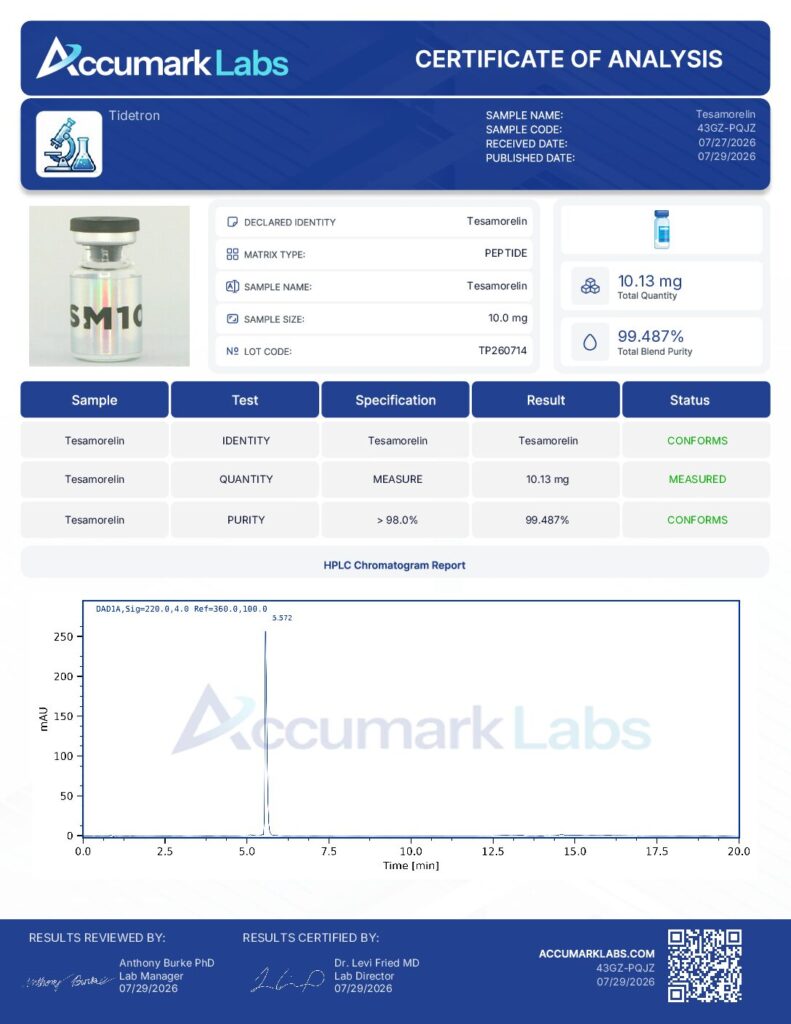
Certificates of Analysis and supporting analytical records should be accessible wherever available.
Nexigen’s objective is to provide clear research-material identification and available product information so materials can be evaluated using analytical evidence rather than generalized promotional statements.
Tesamorelin Research Information
Nexigen Peptides provides available product information associated with its research materials.
Depending upon the testing performed for a particular tesamorelin lot, documentation may include:
- Compound identity
- Material form
- Lot or batch number
- Testing date
- Analytical methodology
- Reported chromatographic result
- Molecular-identity information
- Testing laboratory information
- Original analytical report
Results apply only to the material and lot identified in the corresponding documentation.
How Is Tesamorelin Research Material Evaluated?
Synthetic peptide research materials can be evaluated using multiple analytical techniques.
High-Performance Liquid Chromatography
HPLC can be used to separate components within a peptide sample and evaluate chromatographic composition under defined analytical conditions.
The resulting chromatogram provides information regarding the material under the specific methodology used.
Mass Spectrometry
Mass spectrometry can provide complementary molecular information useful in evaluating peptide identity.
Sequence-Related Characterization
Because tesamorelin is a 44-residue synthetic peptide containing a defined N-terminal modification, identity-related analytical information is particularly important.
Orthogonal Analysis
Chromatographic purity and molecular identity are different analytical questions.
Where multiple analytical techniques are available, researchers can obtain a more complete characterization of the material than from a single percentage alone.
Why Batch-Specific Testing Matters for Tesamorelin
A compound name identifies the intended research material, but analytical evidence should correspond to the specific material that was actually tested.
Product-specific information can help establish:
- Which lot was analyzed
- Which chemical form was evaluated
- When testing was performed
- Which analytical methodology was used
- What result was reported
- Whether molecular-identity information was obtained
- Whether the documentation matches the material being ordered
For this reason, Nexigen recommends reviewing current research information rather than relying exclusively on generalized company-wide purity statements.
Laboratory Handling
Handling and preparation requirements depend upon the experimental design, analytical methodology and laboratory protocol.
Researchers should follow validated laboratory procedures, applicable scientific literature and available product information when preparing or handling Tesamorelin research material.
Relevant experimental variables may include:
- Peptide concentration
- Solution composition
- pH
- Temperature
- Container compatibility
- Sample preparation
- Analytical methodology
- Duration of experimental exposure
Nexigen Peptides does not provide human or veterinary preparation, dosing, injection or administration instructions.
Storage of Tesamorelin Research Material
Store the material according to the conditions specified in the applicable product documentation and available lot-specific analytical records.
Laboratory personnel should use appropriate procedures to minimize unnecessary exposure to moisture, light, temperature fluctuations and other environmental conditions that could affect peptide integrity.
Where validated compound-specific or lot-specific stability information is available, researchers should follow that documentation rather than generalized storage recommendations.
Current Directions in GHRH and Tesamorelin-Related Research
Growth hormone-releasing hormone biology remains an active area of molecular and endocrine research.
Recent research has examined GHRH-R activation, molecular signaling, receptor variants and regulation in multiple experimental systems.
Other research has focused on advances in understanding how GHRH regulates endocrine signaling, including work using receptor-specific tools, modern imaging techniques and cell-specific experimental models.
Scientific reviews have also examined the broader biology of GHRH and its analogs, demonstrating that GHRH-related molecular research continues beyond the earliest endocrine studies.
Clinical literature continues to evaluate tesamorelin in its established pharmaceutical research context.
Clinical research involving pharmaceutical tesamorelin should not be interpreted as demonstrating the characteristics, safety or efficacy of Nexigen’s laboratory research material.
Tesamorelin Research Resources
What Is Tesamorelin?
A scientific introduction to Tesamorelin, GHRH and GHRH receptor biology.
Tesamorelin Sequence, Structure and Molecular Characteristics
Explore the 44-residue sequence, N-terminal modification, molecular identity and material-form distinctions.
→ /tesamorelin-sequence-structure/
Tesamorelin Research in 2026
Review recent scientific literature involving Tesamorelin and GHRH biology.
Tesamorelin Analytical Testing
Learn how HPLC, LC-MS and complementary analytical methods can be used to characterize Tesamorelin research material.
→ /tesamorelin-analytical-testing/
Selected Scientific References
Growth Hormone-Releasing Hormone Receptor and Its Signaling
A 2025 review of GHRH receptor activation, regulation and molecular signaling.
PMID: 39934495
Update on Regulation of GHRH and Its Actions on GH Secretion
A 2025 review emphasizing modern experimental methods used to investigate GHRH signaling and regulation.
PMID: 39838154
Growth Hormone-Releasing Hormone and Its Analogues in Health and Disease
A comprehensive 2025 review of GHRH biology and experimental analog research.
Nature Reviews Endocrinology — PMID: 39537825
Tesamorelin Chemical Identity
PubChem provides chemical identity, sequence, molecular formula, molecular weight and research synonyms associated with tesamorelin.
PubChem CID: 16137828
Tesamorelin Research FAQ
What is tesamorelin?
Tesamorelin is a synthetic peptide analog of human growth hormone-releasing hormone, or GHRH. It has been investigated in research involving GHRH receptor signaling and endocrine molecular pathways.
Is tesamorelin a peptide?
Yes. Tesamorelin is a synthetic peptide related to the 44-amino-acid human GHRH sequence.
How many amino acids are in tesamorelin?
Tesamorelin contains a GHRH-derived sequence of 44 amino-acid residues with an N-terminal chemical modification.
What is the tesamorelin sequence?
The peptide sequence is:
YADAIFTNSYRKVLGQLSARKLLQDIMSRQQGESNQERGARARL
What is the CAS number for tesamorelin?
Tesamorelin is identified by:
CAS 218949-48-5
The exact chemical form supplied by Nexigen should always be confirmed against the current lot documentation.
What is the molecular formula of tesamorelin?
The molecular formula reported for tesamorelin is:
C221H366N72O67S
Exact chemical information should correspond to the material form identified in Nexigen’s applicable research information.
What is the molecular weight of tesamorelin?
Tesamorelin has an approximate molecular weight of:
5136 g/mol
What is TH9507?
TH9507 is a research-development identifier associated with tesamorelin.
What is the relationship between tesamorelin and GHRH?
Tesamorelin is a synthetic analog derived from human growth hormone-releasing hormone. GHRH interacts with the GHRH receptor, a G-protein-coupled receptor studied extensively in endocrine signaling research.
Is tesamorelin an FDA-approved drug ingredient?
Yes. Tesamorelin is the active ingredient in FDA-approved prescription products including EGRIFTA SV and EGRIFTA WR.
The Nexigen laboratory research material should not be represented as those FDA-approved pharmaceutical products.
Does Nexigen provide Tesamorelin research information?
available product information may be provided for Nexigen Tesamorelin research material.
Researchers should verify that documentation corresponds to the specific lot being evaluated.
How can Tesamorelin research material be analyzed?
Depending upon the research objective, peptide analytical techniques such as chromatography and mass spectrometry may provide complementary information concerning sample composition and molecular identity.
Does Nexigen provide Tesamorelin dosing instructions?
No. Nexigen Peptides does not provide human or personal-use guidance.
What is Nexigen Tesamorelin intended for?
Nexigen Tesamorelin is supplied exclusively for legitimate laboratory, analytical and scientific research.
Research Use Only
Nexigen Tesamorelin 10 mg is supplied exclusively for legitimate laboratory, analytical and scientific research.
This material is not represented as EGRIFTA, EGRIFTA SV, EGRIFTA WR or any FDA-approved pharmaceutical product and is not intended for human or veterinary use or consumption, clinical use, diagnosis, treatment, cure or prevention of disease.
Nexigen Peptides does not provide medical advice, human or personal-use guidance.
Tesamorelin Research at a Glance
Quick Answer
Tesamorelin 10 mg Research Material is presented by Nexigen as a research peptide for legitimate laboratory, analytical and scientific research.
Key Facts
- Research material: Tesamorelin
- Page type: Product-specific research material page
- Related research resources: 5
- Aliases/search terms: tesamorelin
Evidence Interpretation
Research findings linked from this page may come from biochemical, cellular, animal or human studies depending on the compound. Those evidence levels answer different questions and should not be treated as interchangeable.
What This Page Does Not Establish
This page does not establish human or veterinary safety, efficacy, dosing, administration or a clinical indication. Nexigen does not provide personal-use guidance.