Quick answer: Semax + Selank 10 mg Research Peptide Blend is presented by Nexigen as a research peptide blend for legitimate laboratory, analytical and scientific research. This page provides product-specific research context and links to related Nexigen research resources.
Semax + Selank Research Peptide Blend — Product Overview
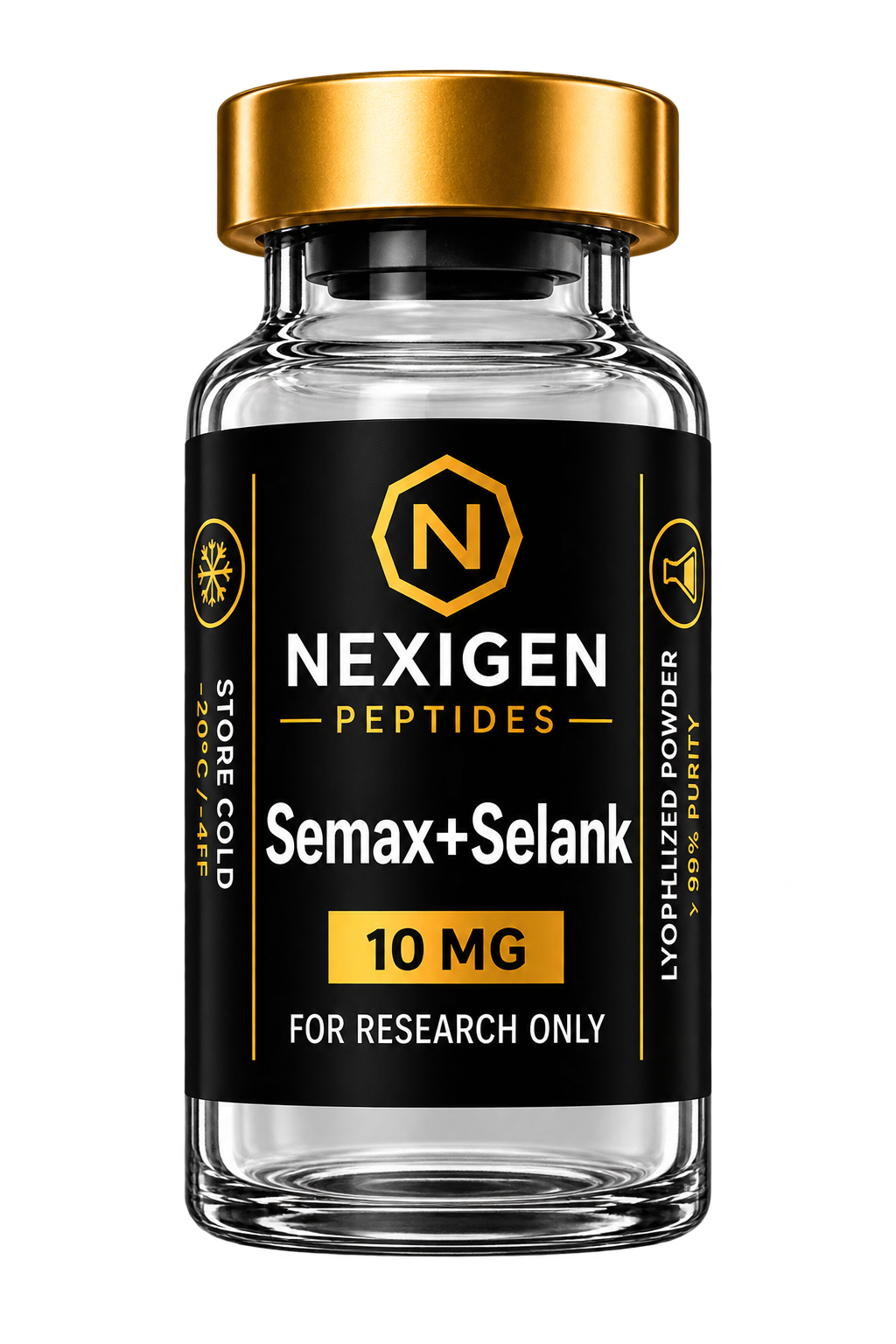
Semax + Selank 10 mg is a two-component synthetic peptide formulation supplied by Nexigen Peptides for laboratory, analytical and scientific research.
The formulation combines two distinct seven-residue peptides:
Semax
Met-Glu-His-Phe-Pro-Gly-Pro
MEHFPGP
Selank
Thr-Lys-Pro-Arg-Pro-Gly-Pro
TKPRPGP
Semax and Selank are chemically distinct research peptides, although both contain the C-terminal Pro-Gly-Pro (PGP) sequence motif. Their structural similarities and differences have made them subjects of experimental research involving peptide stability, enzymatic interactions, molecular signaling and peptide-associated biochemical systems. PubChem
Nexigen Semax + Selank 10 mg is supplied exclusively as a laboratory research material.
The combination of two peptides in a single research formulation should not be interpreted as evidence of synergy, therapeutic activity or equivalence to studying either peptide independently. Experimental results depend on formulation composition, concentration, methodology and the biological or analytical system being studied.
FOR LABORATORY RESEARCH ONLY. NOT FOR HUMAN, VETERINARY OR PERSONAL USE OR CONSUMPTION.
Semax + Selank 10 mg — Research Specifications
| Specification | Information |
|---|---|
| Product Name | Semax + Selank |
| Quantity | 10 mg total research material |
| Material Type | Two-component synthetic peptide blend |
| Semax Sequence | Met-Glu-His-Phe-Pro-Gly-Pro |
| Semax Sequence Code | MEHFPGP |
| Selank Sequence | Thr-Lys-Pro-Arg-Pro-Gly-Pro |
| Selank Sequence Code | TKPRPGP |
| Shared Structural Motif | C-terminal Pro-Gly-Pro |
| Semax CAS Number | 80714-61-0 |
| Selank CAS Number | 129954-34-3 |
| Semax PubChem CID | 9811102 |
| Selank PubChem CID | 11765600 |
| Semax Molecular Weight | Approximately 813.9 g/mol |
| Selank Molecular Weight | Approximately 751.9 g/mol |
| Component Ratio | Refer to current Nexigen product/batch documentation |
| Material Form | Refer to current product documentation |
| Intended Use | Laboratory research only |
PubChem identifies Semax as the heptapeptide H-Met-Glu-His-Phe-Pro-Gly-Pro-OH, with a molecular weight of approximately 813.9 g/mol. Selank is identified as H-Thr-Lys-Pro-Arg-Pro-Gly-Pro-OH, with a molecular weight of approximately 751.9 g/mol. PubChem
Important Blend-Identity Note
Because Semax + Selank contains two different peptide molecules, the blend does not have one meaningful single molecular formula, molecular weight or CAS number.
Individual chemical identifiers should therefore be reported for each peptide component rather than assigning a single molecular identity to the complete blend.
The exact component ratio and material form should correspond to the actual Nexigen production and batch documentation.
What Is Semax?
Semax is a synthetic seven-residue peptide with the sequence:
Met-Glu-His-Phe-Pro-Gly-Pro
MEHFPGP
It is structurally related to an N-terminal region of adrenocorticotropic hormone, or ACTH, with an added Pro-Gly-Pro sequence. PubChem identifies Semax under CID 9811102 and CAS 80714-61-0. PubChem
Scientific research involving Semax has examined molecular and biochemical processes including peptide binding, peptide degradation and neurotrophic signaling in experimental systems.
For example, laboratory and animal research has investigated Semax-associated changes in BDNF and TrkB expression in rat experimental models. These observations represent specific experimental findings and should not be interpreted as established human outcomes or as claims regarding the Nexigen research material. PubMed
Nexigen supplies Semax only as a laboratory research material.
What Is Selank?
Selank is a synthetic seven-residue peptide represented by the sequence:
Thr-Lys-Pro-Arg-Pro-Gly-Pro
TKPRPGP
PubChem identifies Selank under CID 11765600 and CAS 129954-34-3. PubChem
Selank has been investigated in peptide-biochemistry and receptor-associated experimental systems. Research has included studies involving peptide metabolism, enzyme interactions and GABA-associated binding systems. PubMed
These research observations are specific to the experimental systems and methodologies used in the individual studies. They should not be generalized into clinical, therapeutic or consumer claims.
Nexigen supplies Selank only as a laboratory research material.
Shared Structural Characteristics of Semax and Selank
Semax and Selank have different amino-acid sequences but share several structural characteristics relevant to laboratory peptide research.
Both are:
- synthetic heptapeptides;
- seven amino acids in length;
- proline-rich peptides;
- terminated with a Pro-Gly-Pro sequence;
- represented in scientific literature involving regulatory-peptide and glyproline research.
Research literature has examined Pro-Gly-Pro-containing peptides in relation to peptide stability, enzymatic degradation and biochemical activity. PubMed
These similarities make comparison of Semax and Selank useful in controlled experimental systems while their different N-terminal sequences allow researchers to examine how peptide structure may affect experimental behavior.
Semax + Selank in Biochemical Research
A particularly relevant study examined Semax and Selank together in an experimental enzyme system.
Researchers investigated the interaction of both peptides with enkephalin-degrading enzymes in human serum. The study reported concentration-dependent inhibition under the specific in-vitro conditions used and also examined peptide fragments of Semax and Selank. PubMed
This type of research provides an example of how the two peptides can be evaluated comparatively at the biochemical level.
It does not establish therapeutic effectiveness, clinical equivalence, human benefit or synergistic activity of a combined Semax + Selank formulation.
Why Study a Semax + Selank Blend?
A multi-component peptide formulation presents analytical and experimental questions that differ from those associated with an individual peptide.
Researchers may evaluate areas such as:
Component Identity
Whether both expected peptide components can be identified using appropriate analytical methodology.
Relative Composition
Whether analytical testing is consistent with the intended formulation ratio.
Chromatographic Behavior
How Semax and Selank separate under a defined chromatographic method.
Mass-Spectrometric Identification
Whether detected molecular ions or related signals are consistent with the expected peptide structures.
Peptide Stability
How each component behaves under defined laboratory conditions.
Peptide-Peptide Experimental Systems
How a mixed peptide system behaves compared with each component evaluated individually.
No biological interaction or synergy should be presumed solely because two peptides are present in the same formulation.
How Is Semax + Selank Research Material Evaluated?
Because this product contains two defined peptides, analytical characterization should consider each component individually as well as the overall formulation.
High-Performance Liquid Chromatography — HPLC
HPLC can separate peptide-associated components under defined chromatographic conditions.
For a two-component formulation, chromatographic evaluation may help researchers examine:
- component separation;
- retention behavior;
- relative chromatographic composition;
- peptide-related impurities;
- batch-to-batch consistency.
A single generalized “purity percentage” may not fully characterize a multi-component peptide formulation unless the analytical method and method of calculation are clearly defined.
Liquid Chromatography–Mass Spectrometry — LC-MS
LC-MS combines chromatographic separation with mass-related detection.
Because Semax and Selank possess different molecular masses, LC-MS may provide useful complementary evidence when investigating the identity of the individual components.
Mass Spectrometry
Mass-spectrometric analysis can provide molecular-mass information that can be compared with expected peptide structures.
The expected parent molecular weights are approximately:
Semax: 813.9 g/mol
Selank: 751.9 g/mol. PubChem
Interpretation should take into account the actual chemical form, counterions, adducts, instrumentation and analytical methodology used.
Why Batch-Specific Documentation Matters
The product name alone does not establish the analytical characteristics of a particular vial or production lot.
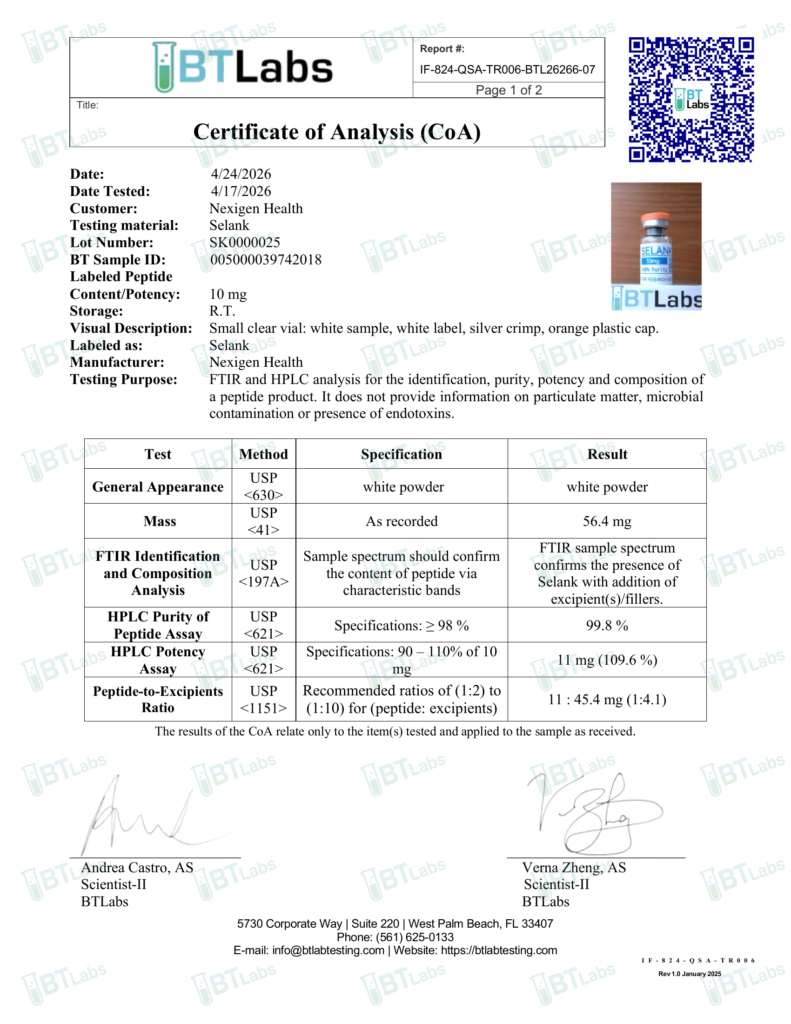
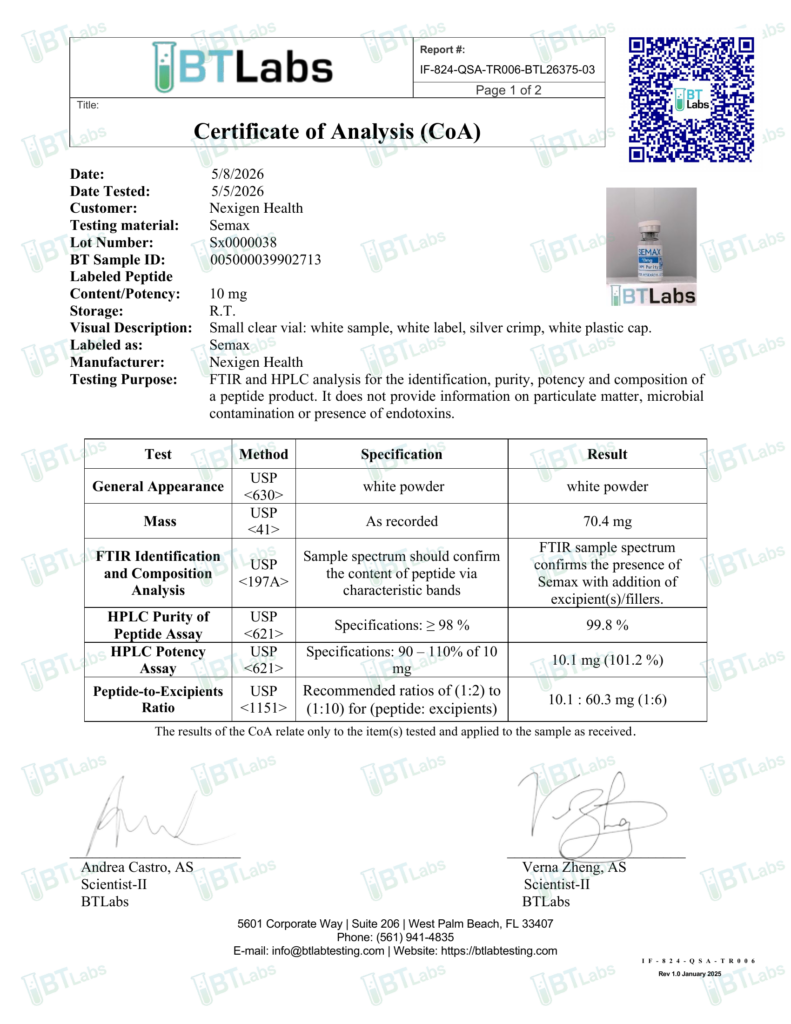
Researchers evaluating Semax + Selank should review available documentation addressing:
- production lot or batch number;
- component identity;
- nominal component quantity;
- formulation ratio;
- analytical methodology;
- chromatographic results;
- molecular-identity information;
- testing date;
- testing laboratory;
- available underlying analytical reports.
Results from one production lot should not automatically be assumed to characterize another lot.
Nexigen’s research-material program should direct customers to the actual batch documentation associated with the material being ordered.
Laboratory Handling
Handling requirements depend on the experimental methodology, material form and laboratory protocol.
Researchers should follow validated laboratory procedures, relevant scientific literature and the current Nexigen product and batch documentation when working with Semax + Selank research material.
Laboratory personnel should minimize unnecessary exposure to:
- moisture;
- excessive heat;
- direct light;
- uncontrolled temperature fluctuations;
- contamination.
Nexigen does not provide human or veterinary dosing, administration, injection or personal-use preparation instructions.
Storage
Store Semax + Selank research material under the conditions specified in the current Nexigen product documentation and corresponding batch records.
Where compound-specific or batch-specific stability information is available, researchers should follow that information rather than generalized peptide-storage assumptions.
I would not put a fixed “24-month shelf life” or “use within X weeks after reconstitution” on this page unless Nexigen actually has stability data supporting those claims.
Research-Use Limitation
Nexigen Semax + Selank 10 mg is intended exclusively for legitimate laboratory, analytical and scientific research.
It is not intended for:
- human use;
- veterinary use;
- consumption;
- clinical use;
- diagnosis;
- treatment;
- prevention of disease;
- personal wellness use;
- cosmetic use;
- administration or injection.
Nexigen does not provide medical advice, personal-use guidance, dosing recommendations or administration protocols.
FAQ Section
What is Semax + Selank 10 mg?
Semax + Selank 10 mg is a two-component synthetic peptide research formulation containing Semax and Selank. It is supplied by Nexigen Peptides exclusively for laboratory, analytical and scientific research.
What is the amino-acid sequence of Semax?
Semax is the seven-residue peptide:
Met-Glu-His-Phe-Pro-Gly-Pro — MEHFPGP. PubChem
What is the amino-acid sequence of Selank?
Selank is the seven-residue peptide:
Thr-Lys-Pro-Arg-Pro-Gly-Pro — TKPRPGP. PubChem
Are Semax and Selank the same peptide?
No. They are different seven-residue peptides with different molecular compositions and molecular weights. They do, however, share a C-terminal Pro-Gly-Pro sequence.
Does 10 mg mean 10 mg of each peptide?
The component quantity and ratio should be determined from the specific Nexigen product specification and current batch documentation. The total vial quantity alone should not be used to infer the amount of each component.
Once you confirm whether this product is specifically 5 mg Semax + 5 mg Selank, I would change this FAQ answer to state that directly.
How can Semax + Selank be analytically evaluated?
Analytical methods used for synthetic peptide formulations may include HPLC, LC-MS and mass spectrometry. The appropriate method depends upon the research objective and actual material being evaluated.
Is Nexigen Semax + Selank intended for human use?
No. Nexigen Semax + Selank is supplied exclusively for laboratory, analytical and scientific research and is not intended for human or veterinary use or consumption.
Scientific References Section
I would add these at the bottom of the product page because they strengthen the page enormously for SEO, AI search and scientific credibility without making consumer claims.
Semax — PubChem
PubChem CID: 9811102
Sequence: MEHFPGP
CAS: 80714-61-0. PubChem
Selank — PubChem
PubChem CID: 11765600
Sequence: TKPRPGP
CAS: 129954-34-3. PubChem
Semax and Selank Inhibit the Enkephalin-Degrading Enzymes from Human Serum
PMID: 11443939. PubMed
Semax, an Analog of ACTH(4-10) with Cognitive Effects, Regulates BDNF and TrkB Expression in the Rat Hippocampus
PMID: 16996037. PubMed
Semax, an Analogue of Adrenocorticotropin (4-10), Binds Specifically and Increases Levels of BDNF Protein in Rat Basal Forebrain
PMID associated with the published study available through PubMed. PubMed
Natural and Hybrid (“Chimeric”) Stable Regulatory Glyproline Peptides
PMID: 15837162.