Klow Blend Research Material — Product Overview
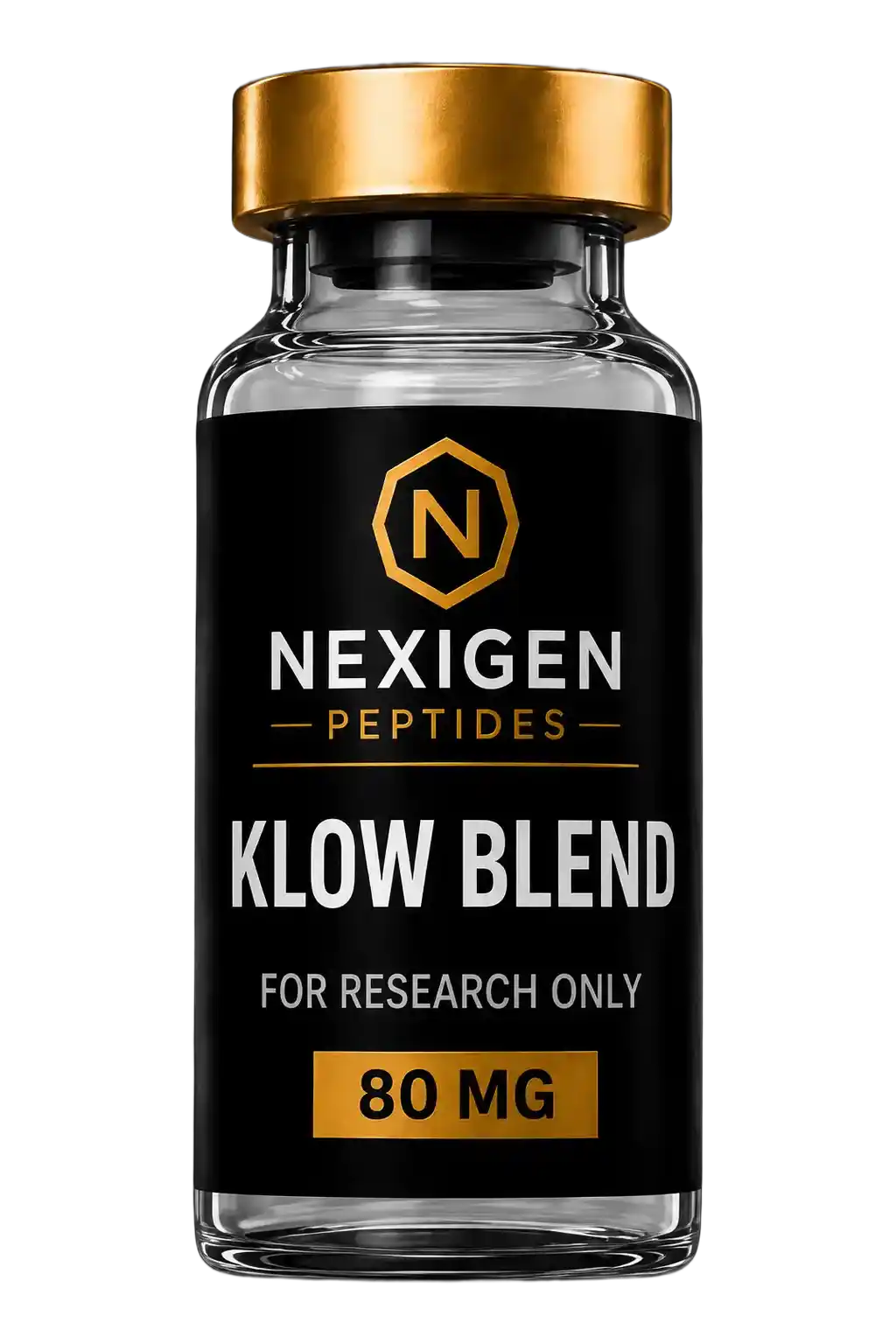
Klow Blend is a branded multi-component peptide research formulation supplied by Nexigen Peptides for laboratory, analytical and scientific investigation.
Unlike an individual peptide compound, Klow Blend represents a defined research formulation containing multiple peptide-associated components within the same material.
Multi-component peptide systems can present different analytical considerations from single-component research materials. Researchers evaluating a peptide blend should consider formulation identity, lot traceability, analytical methodology, batch-specific documentation and the requirements of the experimental system being used.
Nexigen Klow Blend 80 mg is supplied exclusively as a laboratory research material.
The information on this page is provided to identify the product, explain relevant scientific and analytical considerations associated with peptide research blends and provide access to available lot-specific documentation.
This material is intended strictly for laboratory research and is not intended for human or veterinary use or consumption.
Klow Blend 80 mg — Research Specifications
| Specification | Information |
|---|---|
| Product Name | Klow Blend |
| Quantity | 80 mg total research material |
| Material Type | Multi-component peptide research blend |
| Physical Form | Refer to current product documentation |
| Brand | Nexigen Peptides |
| Lot / Batch | Refer to current lot documentation |
| Formulation Identity | Refer to applicable batch documentation |
| Analytical Method | Refer to applicable batch documentation |
| Reported Analytical Result | Refer to current batch documentation |
| Intended Use | Laboratory research only |
Important Scientific Note
Klow Blend is a multi-component research formulation rather than one standardized chemical molecule.
For that reason, the complete blend should not be represented using one generic CAS number, molecular formula, molecular weight or amino-acid sequence as though Klow Blend were one individual peptide.
Researchers should rely on the formulation identity and analytical information associated with the specific Nexigen production lot.
What Is Klow Blend?
Klow Blend is a branded multi-component peptide research formulation supplied by Nexigen Peptides for laboratory, analytical and scientific investigation.
The name Klow Blend identifies the complete research formulation rather than a universally standardized single peptide molecule.
Because branded peptide blends can differ between suppliers, researchers should not assume that every material sold under a similar commercial name has identical composition, analytical characteristics or manufacturing specifications.
For reproducible research, investigators should evaluate the product and lot-specific documentation associated with the actual Klow Blend material being used.
Nexigen supplies Klow Blend exclusively as a laboratory research peptide blend.
Is Klow Blend a Single Peptide?
No.
Klow Blend is a multi-component peptide research formulation, not one individual peptide molecule.
That distinction matters scientifically.
An individual peptide may generally be described using one defined molecular identity, molecular weight, amino-acid sequence and chemical identifier.
A multi-component peptide blend instead needs to be evaluated according to:
- Formulation identity
- Total material quantity
- Production lot
- Analytical methodology
- Batch-specific results
- Applicable formulation documentation
Researchers should therefore use the analytical records associated with the specific Klow Blend lot rather than attempting to describe the complete formulation using the chemical properties of one molecule.
What Is a Research Peptide Blend?
A research peptide blend is a laboratory material containing multiple peptide components within a defined formulation.
Multi-component materials can create different analytical challenges from single-compound samples because different molecular species may demonstrate different:
- Chromatographic retention
- Ionization behavior
- Molecular masses
- Stability characteristics
- Analytical responses
For that reason, researchers evaluating peptide blends should examine the analytical methodology used rather than relying solely on a generalized purity statement.
Research involving defined peptide pools has demonstrated the usefulness of UHPLC combined with high-resolution mass spectrometry for evaluating peptide identity, relative concentration, impurities and other characteristics within complex peptide mixtures.
Klow Blend Research Context
Klow Blend is a branded laboratory research formulation.
Published scientific literature provides extensive information concerning peptide chemistry, peptide mixtures, analytical characterization and quality-control methods. However, findings involving an individual peptide or a different peptide mixture should not automatically be attributed to the complete Nexigen Klow Blend formulation.
Researchers should distinguish between research involving an individual peptide material and research involving the complete Klow Blend formulation.
Unless a publication specifically evaluates the exact formulation under comparable experimental conditions, results involving separate peptide materials should not be represented as demonstrated characteristics of Klow Blend itself.
This distinction helps preserve scientific accuracy and supports appropriate interpretation of published peptide research.
Analytical Characterization of Multi-Component Peptide Research Materials
Analytical characterization is especially important for multi-component peptide research materials.
No single analytical measurement necessarily provides every type of information a researcher may need.
High-Performance Liquid Chromatography
High-performance liquid chromatography, commonly abbreviated HPLC, can separate sample components according to their interactions with a chromatographic system.
For a peptide blend, individual components and related species may produce multiple chromatographic signals.
The resulting profile depends on factors including:
- Column chemistry
- Mobile phase
- Gradient
- Temperature
- Detector
- Sample concentration
UHPLC
Ultra-high-performance liquid chromatography can provide higher efficiency and faster separations under appropriate analytical conditions.
Recent research has demonstrated substantial improvements in peptide-analysis throughput using tandem-column UHPLC while maintaining specificity for difficult peptide-associated molecular modifications.
Mass Spectrometry
Mass spectrometry provides molecular information complementary to chromatographic separation.
For multi-component research materials, LC-MS can help associate chromatographic signals with individual molecular species.
High-Resolution Mass Spectrometry
High-resolution mass spectrometry can provide additional specificity when closely related molecular species or low-abundance impurities are difficult to distinguish.
Recent research has demonstrated how high-resolution MS can identify and quantify peptide-related impurities that may coelute during conventional chromatographic analysis.
These techniques answer different analytical questions.
Researchers should therefore review the methods actually reported for the applicable Klow Blend lot.
How Should Purity Be Interpreted for a Peptide Blend?
A purity percentage should always be interpreted within the context of the analytical method that generated it.
That is particularly important for a multi-component material such as Klow Blend.
A chromatographic percentage may describe the relative detector signals observed under one analytical condition, but it does not automatically establish:
- Complete formulation identity
- Structural identity of every component
- Absence of coeluting material
- Quantitative composition of every molecular species
Research has shown that relative detector responses can materially affect the quantitative interpretation of peptide impurities during HPLC analysis.
Other analytical work has demonstrated that LC-HRMS can resolve and quantify peptide-related impurities that may not be adequately separated by conventional RP-HPLC alone.
For that reason, batch-specific analytical results should be considered together with the analytical method and applicable lot information.
Evaluating Klow Blend as a Research Peptide Blend
Researchers evaluating Klow Blend should consider several factors.
Formulation Identity
The supplied material should correspond to a defined and documented research formulation.
Total Quantity
The Nexigen product represented on this page contains 80 mg total research material.
Lot Traceability
The material should be traceable to a specific production lot.
Analytical Methodology
Researchers should be able to determine which analytical methods were used to characterize the applicable batch.
Batch-Specific Results
An analytical result associated with one production lot should not automatically be assumed to characterize another.
Documentation Availability
Available Certificates of Analysis or corresponding analytical reports should be accessible to research customers.
Research-Use Designation
The intended laboratory purpose of the material should be clearly identified.
Nexigen’s objective is to make relevant product and batch information accessible so researchers can evaluate research materials using documented analytical evidence.
Klow Blend Batch Documentation
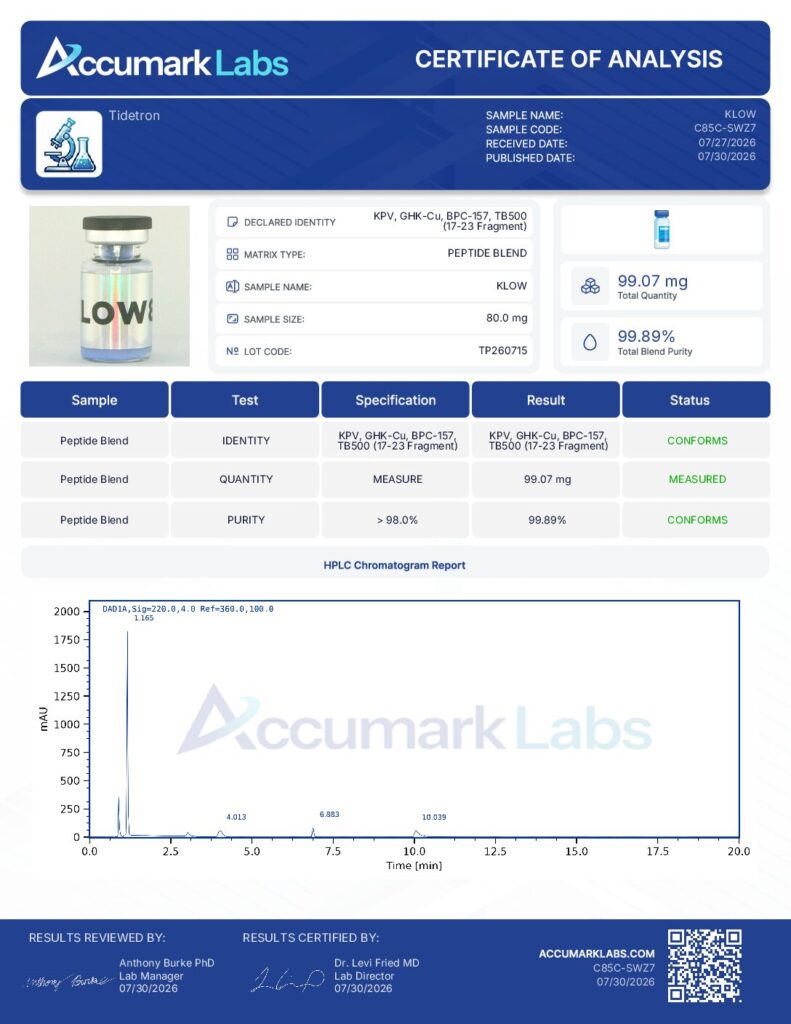
Nexigen Peptides provides available lot-specific analytical documentation associated with its laboratory research materials.
Depending upon the analytical testing performed for a particular Klow Blend lot, documentation may include:
- Product identification
- Formulation identification
- Lot or batch number
- Analytical testing date
- Analytical methodology
- Reported analytical results
- Identity-related information
- Testing laboratory information
- Original analytical report
Results apply only to the material and lot identified in the corresponding documentation.
Why Lot Traceability Matters for Peptide Research Blends
A product name identifies a research material, but the name alone cannot identify which specific batch was tested.
Lot traceability connects the research material with its analytical records.
Batch-specific documentation may help researchers determine:
- Which material was produced
- Which production lot was analyzed
- When testing occurred
- Which analytical methods were used
- What results were reported
- Whether the analytical record corresponds to the material being ordered
This becomes particularly important for multi-component research formulations because analytical characteristics may be more complex than those of a single defined peptide.
Current Developments in Peptide Blend and Peptide-Mixture Analysis
Peptide analytical science continues to develop rapidly.
Peptide Pools and Complex Mixtures
Research into defined peptide pools has demonstrated that UHPLC-HRMS can provide information about expected peptide identities, relative concentrations, synthesis-related impurities, degradation species and analytical artifacts within complex peptide mixtures.
LC-HRMS Impurity Analysis
High-resolution mass-spectrometric methods have been developed for quantitative peptide-impurity analysis, demonstrating the increasing role of LC-HRMS in peptide quality characterization.
Coeluting Peptide Impurities
High-resolution mass spectrometry can help identify and quantify structurally similar peptide impurities that conventional chromatography may have difficulty separating completely.
High-Throughput Peptide Analysis
Recent research has demonstrated tandem-column UHPLC strategies capable of increasing peptide-analysis throughput while maintaining analytical specificity for challenging molecular modifications.
These developments reinforce an important principle for multi-component peptide research materials: the analytical method and lot-specific data matter more than a generalized marketing purity statement.
Laboratory Handling
Handling and preparation requirements depend upon the research design, analytical methodology and experimental protocol.
Researchers should follow validated laboratory procedures, applicable scientific literature and available lot-specific documentation when preparing or handling Klow Blend research material.
For multi-component peptide formulations, experimental variables may include:
- Material concentration
- Solution composition
- pH
- Temperature
- Sample preparation
- Container compatibility
- Analytical methodology
- Duration of experimental exposure
Nexigen Peptides does not provide human or veterinary preparation, dosing, injection or administration instructions.
Storage of Klow Blend Research Material
Store Klow Blend according to the conditions specified in the applicable product documentation and available lot-specific analytical records.
Laboratory personnel should use appropriate practices to minimize unnecessary exposure to moisture, light, temperature fluctuations and other environmental conditions that could affect research-material integrity.
Because Klow Blend is a multi-component formulation, researchers should rely on storage information associated with the complete material rather than assuming that generalized guidance for an individual peptide applies to the entire blend.
Where validated lot-specific stability information is available, that documentation should take precedence over generalized storage recommendations.
Selected References on Peptide Blend Analytical Characterization
Investigation of Impurities in Peptide Pools
This 2025 research examined complex mixtures of defined peptides and demonstrated the usefulness of UHPLC-HRMS for evaluating peptide identities, relative concentrations, impurities, degradation products and analytical artifacts.
Separations, 2025.
Validation of LC-HRMS for Peptide-Related Impurity Analysis
FDA-affiliated researchers validated a high-resolution mass-spectrometric method for quantitative peptide-impurity analysis.
Journal of Pharmaceutical and Biomedical Analysis, 2025.
PMID: 39778260
High-Resolution MS Analysis of Coeluting Peptide Impurities
A 2025 study demonstrated high-resolution MS analysis of structurally related peptide impurities that conventional chromatographic separation could not completely resolve.
Journal of the American Society for Mass Spectrometry, 2025.
PMID: 40857144
High-Throughput Peptide Mapping Using Tandem-Column UHPLC
A 2026 study demonstrated substantially accelerated peptide analysis while preserving separation specificity.
Analytical Chemistry, 2026.
PMID: 42223027
Klow Blend Research FAQ
What is Klow Blend?
Klow Blend is a branded multi-component peptide research formulation supplied by Nexigen Peptides for laboratory, analytical and scientific investigation.
Is Klow Blend a research peptide?
Klow Blend is more accurately described as a research peptide blend because it contains a defined multi-component formulation rather than one individual peptide molecule.
Is Klow Blend a standardized chemical compound?
No.
Klow Blend is a branded research formulation rather than a universally standardized single chemical compound.
Researchers should use Nexigen’s current product and lot documentation when evaluating the material.
How much material is in Nexigen Klow Blend?
The Nexigen product represented on this page contains 80 mg total research material.
Does Klow Blend have one CAS number?
A multi-component peptide formulation should not be assigned one generic CAS number as though the entire blend were one molecule.
The relevant material identity should instead be determined from the applicable formulation and batch documentation.
Does Klow Blend have one molecular weight?
Not in the same way as a single defined peptide molecule.
Because Klow Blend is a multi-component research formulation, one molecular weight should not be assigned to the complete blend as though it were one chemical entity.
How can Klow Blend be evaluated analytically?
Depending on the research objective, analytical techniques may include liquid chromatography, high-resolution mass spectrometry and other complementary methods.
Different analytical methods provide different information concerning sample composition and molecular identity.
Why is batch documentation important for Klow Blend?
Batch documentation connects analytical information to the actual research material that was produced and tested.
This is particularly important for multi-component research formulations because the product name alone does not provide complete analytical characterization.
Does Nexigen provide Klow Blend batch documentation?
Available lot-specific analytical documentation may be provided for Nexigen Klow Blend research material.
Researchers should confirm that documentation corresponds to the specific lot being evaluated.
Is Klow Blend intended for personal use?
No.
Nexigen Klow Blend is supplied exclusively for legitimate laboratory, analytical and scientific research and is not intended for human or veterinary use or consumption.
Does Nexigen provide Klow Blend dosing instructions?
No.
Nexigen Peptides does not provide human or veterinary dosing recommendations, injection instructions, administration guidance or treatment protocols.
Does Nexigen provide a Klow Protocol?
No.
Nexigen provides research-material information and available analytical documentation. Laboratory experimental procedures depend upon the research model, analytical methodology and validated protocol selected by the researcher.
Research Use Only
Nexigen Klow Blend 80 mg is supplied exclusively for legitimate laboratory, analytical and scientific research.
This research material is not intended for human or veterinary use or consumption, clinical use, diagnosis, treatment, cure or prevention of disease.
Nexigen Peptides does not provide medical advice, human or veterinary dosing recommendations, injection instructions, administration guidance or personal-use protocols.