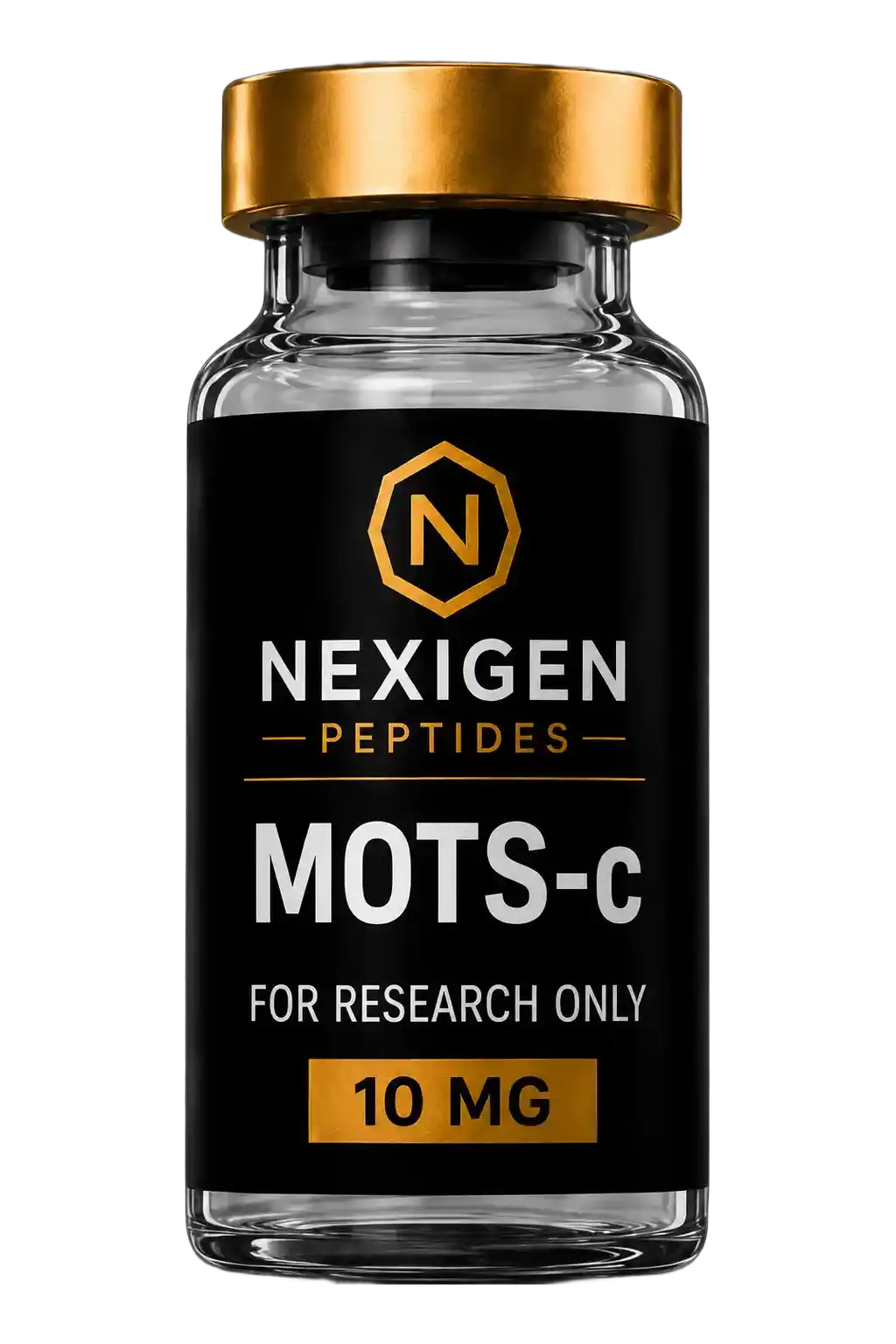
Quick answer: MOTS-c 10 mg Research Peptide is presented by Nexigen as a research peptide for legitimate laboratory, analytical and scientific research. This page provides product-specific research context and links to related Nexigen research resources.
Research Peptides hub · Research guide · Related MOTS-c research
MOTS-c Research Material — Product Overview
MOTS-c, short for Mitochondrial Open Reading Frame of the 12S rRNA Type-c, is a mitochondrial-derived peptide composed of 16 amino acids.
Unlike conventional peptides encoded by nuclear DNA, MOTS-c originates from a short open reading frame associated with the mitochondrial genome. This characteristic has made MOTS-c an important experimental model for studying communication between mitochondrial and nuclear cellular systems.
Research has examined MOTS-c in experimental systems involving mitochondrial signaling, metabolic-stress responses, cellular adaptation and regulation of nuclear gene expression.
Nexigen MOTS-c 10 mg is supplied exclusively as a laboratory research material for analytical and scientific investigation.
The information on this page is provided to identify the material, summarize relevant scientific research context and provide access to available product information.
This product is intended strictly for laboratory research and is not intended for human or veterinary use or consumption.
MOTS-c 10 mg — Research Specifications
MOTS-c 10 mg — Research Specifications
| Specification | Information |
|---|---|
| Compound | MOTS-c |
| Full Name | Mitochondrial Open Reading Frame of the 12S rRNA Type-c |
| Quantity | 10 mg |
| Compound Type | Mitochondrial-derived peptide |
| Peptide Length | 16 amino acids |
| Amino-Acid Sequence | MRWQEMGYIFYPRKLR |
| CAS Number | 1627580-64-6 |
| PubChem CID | 146675088 |
| Molecular Formula | C101H152N28O22S2 |
| Molecular Weight | Approximately 2174.6 g/mol |
| Material Form | Verify against current Nexigen lot documentation |
| Lot / Batch | Refer to current research information |
| Analytical Method | Refer to current research information |
| Reported Result | Refer to current research information |
| Intended Use | Laboratory research only |
MOTS-c Material Form and Analytical Identity
MOTS-c is defined by its 16-amino-acid peptide sequence,
MRWQEMGYIFYPRKLR. However, commercially prepared research
materials may be represented in different associated forms depending on
synthesis, purification, isolation, and final material preparation.
For this reason, researchers should verify that molecular-weight information,
chemical representation, and analytical documentation correspond to the
actual material form associated with the specific production lot.
Database entries and general reference values should not be assumed to describe
every prepared research lot identically.
Lot-specific identity matters:
The Certificate of Analysis and associated analytical documentation for
the specific Nexigen lot should be treated as the controlling reference
for material-form identification, analytical method, and reported result.
Analytical evaluation of MOTS-c may therefore involve more than confirming a
product name. Researchers may consider peptide sequence, expected molecular
mass, chromatographic characteristics, mass-spectrometric identity, and the
specific form documented for the production lot.
Nexigen does not assume that every external database representation,
counter-ion designation, or molecular-weight value applies identically to
every production lot. Current research information should be reviewed when
precise material-form information is required.
PubChem identifies MOTS-c with CAS 1627580-64-6, the sequence MRWQEMGYIFYPRKLR, formula C101H152N28O22S2, and molecular weight approximately 2174.6 g/mol.
Important specification note
PubChem also contains records representing MOTS-c in different material forms, including a trifluoroacetate-associated form with a different formula and molecular weight.
Therefore, before publishing the formula and molecular weight above, confirm that Nexigen’s current COA identifies the same material form.
If Nexigen’s actual product is a TFA salt, use the exact chemical information from the lot documentation instead.
What Is MOTS-c?
MOTS-c is a 16-amino-acid mitochondrial-derived peptide encoded within a short open reading frame associated with mitochondrial 12S ribosomal RNA.
The peptide belongs to a growing group of molecules referred to as mitochondrial-derived peptides, or MDPs.
These molecules are of particular scientific interest because mitochondrial DNA contains information capable of contributing to signaling beyond the mitochondrion itself.
MOTS-c research helped establish an important concept in mitochondrial biology: information flow between mitochondria and the nucleus can occur through mitochondrially encoded signaling molecules.
A foundational Cell Metabolism study demonstrated that MOTS-c can translocate to the nucleus under metabolic-stress conditions and participate in regulation of nuclear gene expression.
Nexigen supplies MOTS-c exclusively as a laboratory research peptide material.
What Does MOTS-c Stand For?
MOTS-c is an abbreviation for:
Mitochondrial Open Reading Frame of the 12S rRNA Type-c
The name reflects the peptide’s relationship to a short open reading frame associated with the mitochondrial 12S ribosomal RNA region.
Unlike most cellular peptides and proteins, whose coding information originates from nuclear DNA, MOTS-c is associated with genetic information contained within mitochondrial DNA.
This makes MOTS-c useful in research involving:
- mitochondrial genetics
- mitochondrial-derived peptides
- mitonuclear communication
- cellular stress signaling
- mitochondrial-to-nuclear signaling
- short open reading frames
What Is the MOTS-c Sequence?
The human MOTS-c peptide contains 16 amino acids.
The sequence reported by PubChem is:
MRWQEMGYIFYPRKLR
This corresponds to:
Met-Arg-Trp-Gln-Glu-Met-Gly-Tyr-Ile-Phe-Tyr-Pro-Arg-Lys-Leu-Arg
Sequence identity is particularly important when evaluating synthetic peptide research materials because peptide name alone does not provide complete analytical characterization.
Researchers should confirm that sequence-related information and available analytical documentation correspond to the actual material being evaluated.
MOTS-c and Mitochondrial-Derived Peptides
MOTS-c belongs to a class of molecules commonly described as mitochondrial-derived peptides.
Mitochondria are best known for their roles in cellular bioenergetics, but modern research increasingly recognizes mitochondria as signaling organelles capable of communicating with other cellular compartments.
Mitochondrial-derived peptides provide one experimental example of this communication.
Research involving MDPs has investigated how small peptides originating from mitochondrial genetic information participate in cellular signaling systems.
MOTS-c is particularly important in this field because studies have connected it with communication between mitochondria and the nucleus.
This research has contributed to a broader area sometimes referred to as mitonuclear communication.
MOTS-c and Mitonuclear Communication
One of the most scientifically distinctive aspects of MOTS-c research is its
relationship to mitonuclear communication—the exchange of
signals between mitochondrial systems and the cell nucleus.
MOTS-c is associated with a short open reading frame within the mitochondrial
12S rRNA region. Experimental research has investigated how this
mitochondrial-genome-associated peptide may participate in cellular signaling
pathways that extend beyond the mitochondrion itself.
Stress-Responsive Nuclear Translocation
Experimental studies have reported that MOTS-c can undergo changes in cellular
localization during metabolic stress, including translocation toward the
nucleus under defined research conditions.
This makes MOTS-c useful as an experimental model for investigating how a
mitochondrial-derived peptide may participate in signaling between
mitochondrial processes and nuclear gene-regulatory systems.
AMPK-Associated Research
MOTS-c research has also examined signaling pathways associated with
AMP-activated protein kinase, commonly abbreviated AMPK.
AMPK is widely studied as a cellular sensor involved in responses to changing
energy and metabolic conditions.
Research involving MOTS-c has explored relationships among metabolic stress,
AMPK-associated signaling, cellular localization, and downstream
transcriptional responses. These findings are studied as mechanistic research
questions rather than as statements about consumer or therapeutic use.
Nuclear Gene Regulation
The ability of a mitochondrial-derived peptide to participate in nuclear
signaling provides an important research framework for studying
mitochondria-to-nucleus communication.
Current work continues to investigate how MOTS-c localization, interacting
proteins, cellular stress conditions, and transcriptional pathways may
contribute to this broader signaling network.
Research context:
MOTS-c is particularly relevant to experimental studies of mitochondrial
signaling, metabolic-stress responses, nuclear translocation, and
mitonuclear communication.
MOTS-c Research Context
MOTS-c has been investigated across multiple areas of mitochondrial and cellular biology.
For the purposes of a laboratory research-material page, the most relevant scientific themes include:
Mitochondrial Signaling
Researchers investigate MOTS-c as part of the broader study of mitochondrial-derived signaling molecules.
Cellular Stress Responses
Experimental work has examined how MOTS-c localization and signaling change when cells encounter defined stress conditions.
Mitonuclear Communication
MOTS-c research has provided a molecular model for studying communication between mitochondrial and nuclear genomes.
Nuclear Gene Regulation
Experimental studies have reported changes in MOTS-c localization to the nucleus under stress conditions and associations with regulation of nuclear gene expression.
AMPK-Associated Signaling
Experimental literature has investigated relationships between MOTS-c signaling and AMP-activated protein kinase, commonly abbreviated AMPK.
AMPK is widely studied as a cellular sensor involved in responses to changes in energy availability.
These findings should be interpreted according to the specific experimental systems and conditions used.
Scientific literature presented on this page is provided solely to identify areas of laboratory investigation and should not be interpreted as claims regarding the safety, effectiveness or intended human use of Nexigen MOTS-c.
MOTS-c and Nuclear Translocation Research
One of the most widely studied characteristics of MOTS-c is its ability to change cellular localization under defined experimental conditions.
A landmark 2018 Cell Metabolism study reported that MOTS-c translocated to the nucleus in response to metabolic stress.
The investigators found that this process involved AMPK-dependent signaling and that nuclear MOTS-c participated in regulation of stress-responsive gene expression.
The research also examined interactions with transcriptional systems associated with antioxidant response elements and stress-response pathways.
More recent work continues to investigate mechanisms associated with MOTS-c nuclear transport.
A 2025 Redox Biology study examined a specific molecular transport mechanism involving MYH9-dependent nuclear translocation and transcriptional regulation in an experimental model.
These studies illustrate how MOTS-c has become a useful experimental tool for investigating mitochondrial-to-nuclear signaling.
They do not establish that Nexigen MOTS-c has a particular clinical or consumer effect.
Experimental Research Characteristics
Several characteristics distinguish MOTS-c from many conventional peptide research materials.
Mitochondrial Genetic Origin
MOTS-c is associated with a short open reading frame within mitochondrial genetic material rather than a conventional nuclear protein-coding gene.
16-Amino-Acid Structure
MOTS-c is a relatively short peptide composed of 16 amino acids.
Stress-Responsive Localization
Published experimental research has described changes in MOTS-c cellular localization under metabolic-stress conditions.
Nuclear Signaling
Research has investigated interactions between MOTS-c and transcriptional responses after nuclear translocation.
Model-Dependent Behavior
MOTS-c observations can depend substantially on:
- cell type
- experimental model
- concentration
- metabolic environment
- duration of exposure
- cellular stress conditions
- assay design
- analytical methodology
Researchers should therefore consult original scientific publications when selecting experimental methods or interpreting MOTS-c results.
Current Directions in MOTS-c Research
MOTS-c remains an active subject of mitochondrial and cellular research.
Recent studies continue to investigate its molecular signaling behavior in increasingly specific experimental systems.
Cellular Signaling Research — 2026
A 2026 study involving human mesenchymal stromal cells examined MOTS-c-associated metabolic signaling and found that experimental outcomes varied according to the cellular functions being measured.
Importantly, the authors reported both signaling changes and limitations in other cellular responses, illustrating that MOTS-c biology is complex and model dependent rather than uniformly beneficial.
Nuclear Transport Research — 2025
A 2025 study investigated the molecular transport of MOTS-c into the nucleus and identified an MYH9-associated pathway within the experimental system.
Mitochondrial-Derived Peptide Research — 2026
A 2026 review describes MOTS-c as a mitochondrial-derived microprotein involved in multiple stress-responsive experimental pathways and emphasizes the continuing need for mechanistic and translational research.
These studies demonstrate that MOTS-c research continues to expand beyond its initial identification toward more detailed investigation of molecular signaling, cellular localization and context-dependent experimental responses.
Nexigen presents this literature as scientific background only.
Evaluating MOTS-c as a Research Peptide
Researchers sourcing MOTS-c or other research peptides should consider more than compound name and vial quantity.
Sequence Identity
The material should correspond to the expected 16-amino-acid sequence:
MRWQEMGYIFYPRKLR
Chemical Form
Researchers should determine whether the supplied material is represented as the free peptide, a TFA-associated material or another documented form.
Lot Traceability
Available analytical documentation should correspond to the actual production lot.
Analytical Methodology
Researchers should know which analytical technique was used to characterize the material whenever possible.
Batch-Specific Results
Results from one lot should not automatically be attributed to subsequent lots.
Documentation Availability
Certificates of Analysis and supporting analytical reports should be accessible wherever applicable.
Research-Use Designation
The intended laboratory use of the material should be clearly communicated.
Nexigen’s objective is to provide researchers with clear material identity and available product information.
MOTS-c Research Information
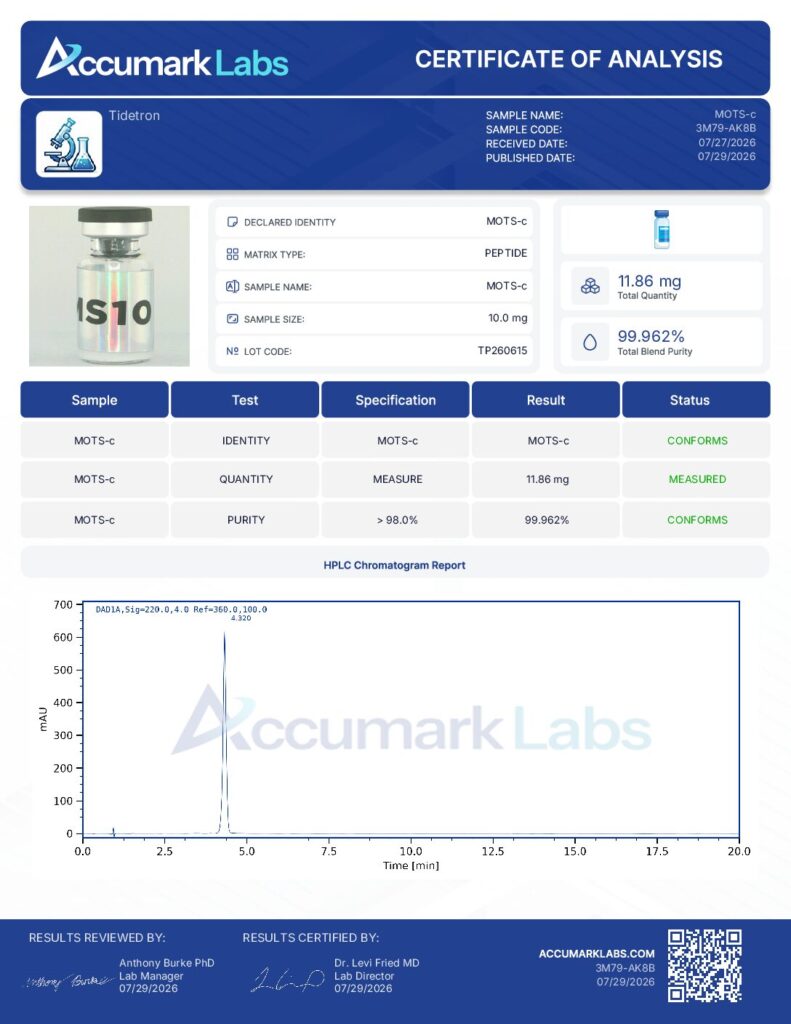
Nexigen Peptides provides available batch-specific analytical documentation associated with its research materials.
Depending upon the testing performed for a particular MOTS-c lot, documentation may include:
- compound identity
- peptide sequence
- material form
- lot or batch number
- analytical testing date
- analytical methodology
- reported chromatographic result
- molecular-identity information
- testing laboratory information
- original analytical report
Analytical results apply only to the material and lot identified in the corresponding documentation.
Researchers should review the applicable Certificate of Analysis or other analytical documentation associated with the current MOTS-c lot.
How Is MOTS-c Research Material Evaluated?
Different analytical methods provide different types of information concerning a synthetic peptide.
High-Performance Liquid Chromatography
HPLC can be used to separate sample components and evaluate chromatographic composition under defined analytical conditions.
A reported chromatographic percentage describes the sample under the methodology used.
Mass Spectrometry
Mass spectrometry can provide complementary molecular information useful in evaluating whether detected material is consistent with the expected peptide.
Sequence-Related Characterization
Because MOTS-c has a defined 16-amino-acid sequence, analytical characterization should be consistent with the expected molecular identity.
Orthogonal Analysis
Chromatographic purity and molecular identity are related but distinct analytical questions.
Where multiple analytical techniques are available, researchers can obtain stronger characterization than from one measurement alone.
Why Batch-Specific Testing Matters for MOTS-c
A product name identifies the intended peptide, but research-quality evaluation should correspond to the actual material tested.
Batch-specific analytical documentation helps researchers determine:
- which peptide lot was evaluated
- which chemical form was analyzed
- when testing occurred
- which analytical technique was used
- what result was reported
- whether identity-related information was obtained
- whether the documentation corresponds to the material being ordered
Nexigen therefore recommends reviewing current lot documentation rather than relying solely on generalized purity statements.
Laboratory Handling
Handling and preparation requirements depend upon the experimental design, analytical methodology and laboratory protocol.
Researchers should follow validated laboratory procedures, applicable scientific literature and available product information when preparing or handling MOTS-c research material.
Relevant laboratory variables may include:
- material concentration
- solution composition
- pH
- temperature
- container compatibility
- sample preparation
- duration of experimental exposure
- analytical methodology
Nexigen Peptides does not provide human or veterinary preparation, dosing, injection or administration instructions.
Storage of MOTS-c Research Material
Store MOTS-c according to the conditions specified in the applicable product documentation and available lot-specific analytical records.
Laboratory personnel should use appropriate procedures to minimize unnecessary exposure to moisture, light, temperature fluctuations and other environmental conditions that could affect peptide integrity.
Where validated compound-specific or lot-specific stability information is available, researchers should follow that documentation rather than generalized storage recommendations.
SCIENTIFIC REFERENCES
MOTS-c Nuclear Translocation and Mitonuclear Signaling
A foundational study demonstrated stress-associated MOTS-c nuclear translocation and regulation of nuclear gene expression in an AMPK-dependent experimental system.
Kim KH, et al. Cell Metabolism. 2018.
PMID: 29983246.
MOTS-c as a Mitochondrial-Encoded Regulator
A scientific review examined MOTS-c as a mitochondrial-derived signaling peptide involved in communication between mitochondrial and nuclear cellular systems.
PMID: 31378979.
Molecular Mechanisms of MOTS-c Nuclear Transport
A 2025 study examined mechanisms associated with MOTS-c nuclear translocation and transcriptional signaling in an experimental cellular model.
PMID: 40403491.
MOTS-c Signaling in Human Cellular Research
A 2026 study investigated MOTS-c signaling in human mesenchymal stromal cells and demonstrated the importance of evaluating distinct, model-dependent experimental outcomes.
PMID: 42324588.
MOTS-c Research Peptide FAQ
What is MOTS-c?
MOTS-c is a 16-amino-acid mitochondrial-derived peptide encoded within a short open reading frame associated with the mitochondrial 12S rRNA region.
What does MOTS-c stand for?
MOTS-c stands for:
Mitochondrial Open Reading Frame of the 12S rRNA Type-c.
Is MOTS-c a peptide?
Yes. MOTS-c is a peptide consisting of 16 amino acids.
What is the MOTS-c amino-acid sequence?
The sequence is:
MRWQEMGYIFYPRKLR
What is the CAS number for MOTS-c?
MOTS-c is commonly identified by:
CAS 1627580-64-6.
What is the molecular formula of MOTS-c?
PubChem reports:
C101H152N28O22S2
for the represented MOTS-c peptide.
The exact form supplied by Nexigen should be confirmed against the current lot documentation.
What is the molecular weight of MOTS-c?
PubChem reports a molecular weight of approximately:
2174.6 g/mol
for its MOTS-c record.
Alternative salt forms can have different molecular weights.
What is a mitochondrial-derived peptide?
A mitochondrial-derived peptide is a small peptide associated with genetic information encoded within the mitochondrial genome. Researchers study these molecules as part of mitochondrial signaling and cellular communication.
What is mitonuclear communication?
Mitonuclear communication refers to signaling between mitochondria and the nucleus. MOTS-c research has helped scientists investigate how a mitochondrially encoded peptide can participate in nuclear signaling under experimental stress conditions.
Does MOTS-c enter the nucleus?
Experimental research has shown that MOTS-c can translocate to the nucleus under defined metabolic-stress conditions. The process has been associated with AMPK-dependent signaling and regulation of stress-responsive nuclear gene expression.
Does Nexigen provide MOTS-c research information?
available product information can be reviewed through the Nexigen Research Information section and, where applicable, directly from the corresponding product record.
Researchers should confirm that documentation corresponds to the specific lot being evaluated.
How can MOTS-c research material be evaluated?
Depending upon the research objective, chromatographic and mass-spectrometric analytical methods can provide complementary information concerning peptide composition and molecular identity.
Does Nexigen provide MOTS-c dosing instructions?
No. Nexigen Peptides does not provide human or personal-use guidance.
What is Nexigen MOTS-c intended for?
Nexigen MOTS-c 10 mg is supplied exclusively for legitimate laboratory, analytical and scientific research.
Research Use Only
Nexigen MOTS-c 10 mg is supplied exclusively for legitimate laboratory, analytical and scientific research.
This material is not intended for human or veterinary use or consumption, clinical use, diagnosis, treatment, cure or prevention of disease.
Nexigen Peptides does not provide medical advice, human or personal-use guidance.
MOTS-c Research at a Glance
Quick Answer
MOTS-c 10 mg Research Peptide is presented by Nexigen as a research peptide for legitimate laboratory, analytical and scientific research.
Key Facts
- Research material: MOTS-c
- Page type: Product-specific research material page
- Related research resources: 6
- Aliases/search terms: mots c
Evidence Interpretation
Research findings linked from this page may come from biochemical, cellular, animal or human studies depending on the compound. Those evidence levels answer different questions and should not be treated as interchangeable.
What This Page Does Not Establish
This page does not establish human or veterinary safety, efficacy, dosing, administration or a clinical indication. Nexigen does not provide personal-use guidance.