Quick answer: GHK-Cu 100 mg Research Peptide is presented by Nexigen as a research peptide for legitimate laboratory, analytical and scientific research. This page provides product-specific research context and links to related Nexigen research resources.
Research Peptides hub · Research guide · Related GHK-Cu research
GHK-Cu Research Material — Product Overview
GHK-Cu is a copper-associated peptide complex formed between copper and the naturally occurring tripeptide glycyl-L-histidyl-L-lysine, commonly abbreviated GHK.
The GHK peptide consists of three amino acids:
Glycine – Histidine – Lysine
The histidine-containing peptide sequence is capable of coordinating copper ions, making GHK-Cu useful as a model system in research involving peptide-metal interactions, copper coordination, molecular structure and cellular biochemical processes.
Nexigen GHK-Cu 100 mg is supplied exclusively as a laboratory research material for analytical and scientific investigation.
The information on this page is provided to identify the research material, summarize relevant scientific context and provide access to available product information.
This material is intended strictly for laboratory research and is not intended for human, veterinary, cosmetic or personal use.
GHK-Cu 100 mg — Research Specifications
| Specification | Information |
| Compound | GHK-Cu |
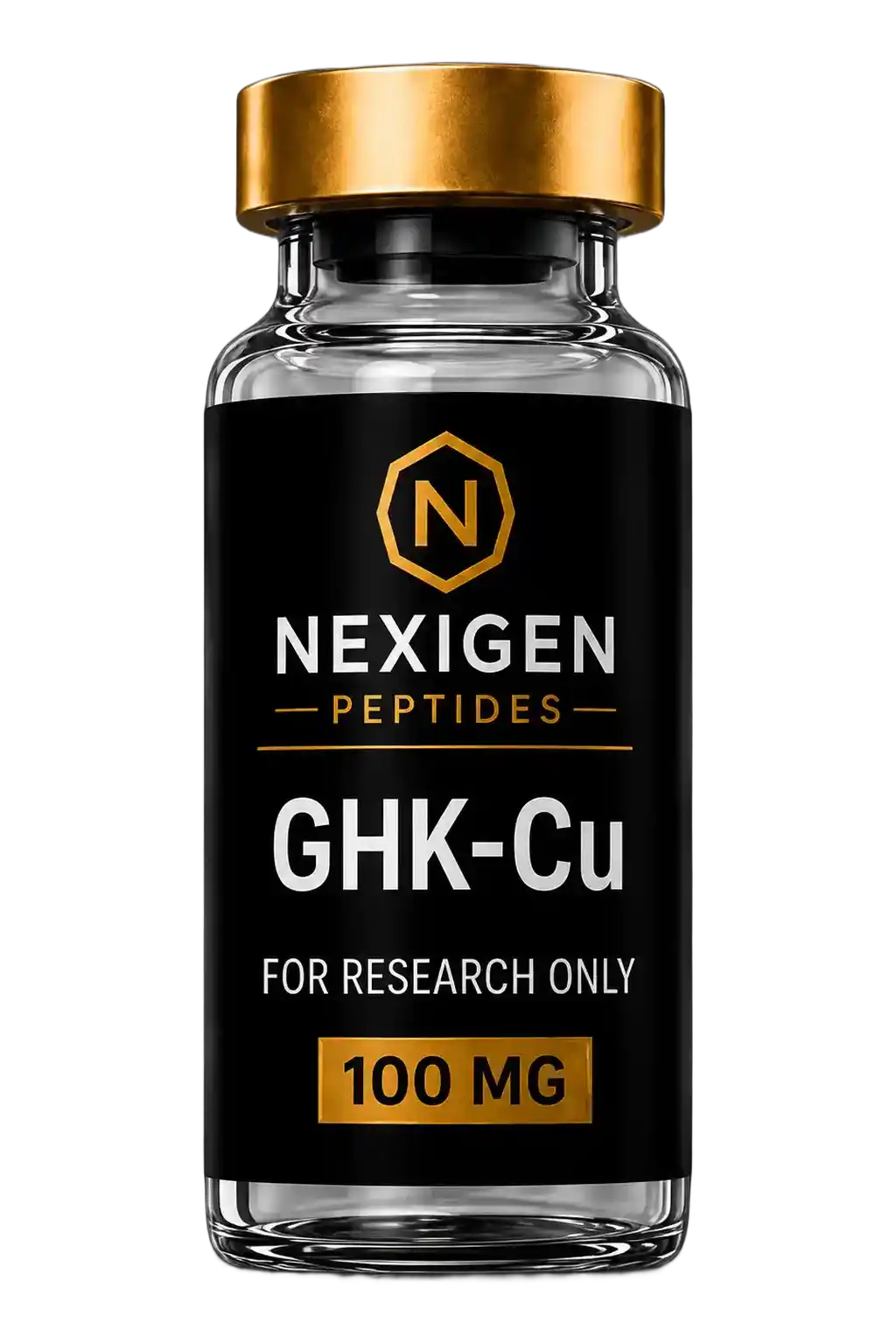
| Quantity | 100 mg |
| Compound Type | Copper-associated tripeptide complex |
| Peptide Component | Glycyl-L-histidyl-L-lysine |
| Peptide Sequence | Gly-His-Lys |
| Metal Component | Copper |
| Form | Lyophilized Powder |
| Brand | Nexigen Peptides |
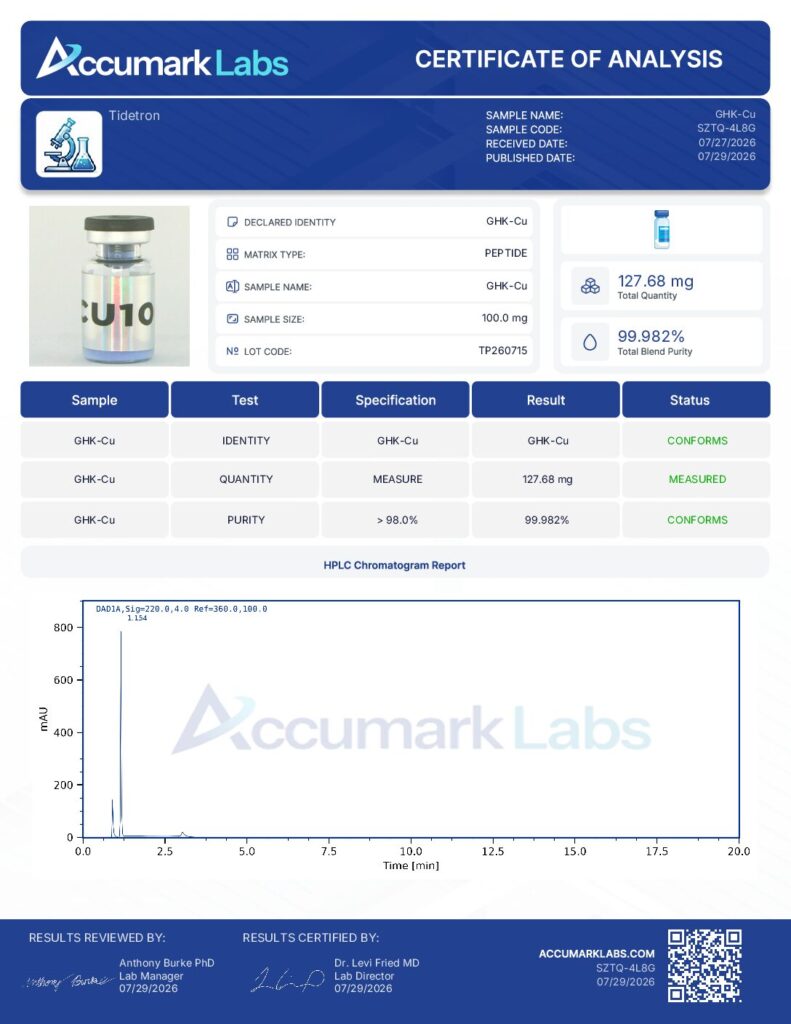
| Lot / Batch | TP260715 |
| Analytical Method | Quantity/Purity |
| Reported Result | 127.68 mg / 99.982% |
| Intended Use | Laboratory research only |
Important chemical-identity note
GHK-Cu can be represented in more than one coordination, ionic or hydration state in chemical databases. PubChem currently contains multiple GHK-Cu records with different formulas and calculated molecular weights depending on how the copper-peptide complex is represented.
For that reason, the molecular formula, molecular weight and chemical identifier displayed for the Nexigen product should match the specific form identified in the current lot documentation or Certificate of Analysis.
What Is GHK-Cu?
GHK-Cu is a copper-peptide complex involving the tripeptide glycyl-L-histidyl-L-lysine (GHK) and copper ions.
GHK contains glycine, histidine and lysine. The histidine residue contributes to the peptide’s ability to participate in copper coordination.
The interaction between GHK and copper has been examined using multiple analytical techniques, including optical spectroscopy, electron paramagnetic resonance and other structural methods.
Classic solution-structure research demonstrated that GHK forms defined copper(II)-associated species and that nitrogen atoms within the peptide participate in copper coordination.
GHK-Cu therefore provides researchers with a useful peptide-metal system for studying coordination chemistry, molecular interactions and related biochemical processes under controlled experimental conditions.
Nexigen supplies GHK-Cu exclusively as a laboratory research material.
GHK-Cu Research Context
GHK-Cu has a long history in biochemical and peptide research.
An important area of investigation involves the ability of the GHK tripeptide to coordinate copper.
Researchers have used spectroscopy, solution chemistry and other analytical approaches to investigate:
Copper-peptide coordination
The interaction between Cu(II) and the Gly-His-Lys peptide has been examined to characterize coordination geometry and the molecular groups involved in complex formation.
Solution behavior
Studies have demonstrated that copper-GHK structures observed in solution can differ from solid-state structural arrangements, highlighting the importance of experimental conditions when characterizing peptide-metal complexes.
Complex stability
Researchers have studied how pH and chemical environment influence the types and stability of copper-GHK species formed in solution.
Interactions with other copper-binding systems
More recent research has investigated GHK-containing copper complexes in the presence of human serum albumin, demonstrating the continuing scientific interest in copper coordination and peptide-metal interactions.
These studies demonstrate why the physical and chemical environment of a peptide-metal complex matters.
Research findings should always be interpreted within the methodology and conditions of the individual experiment.
Nexigen does not represent experimental observations as established human, veterinary or cosmetic outcomes.
Experimental Research Characteristics of GHK-Cu
GHK-Cu differs from an ordinary uncomplexed peptide because the research material incorporates a metal-ion coordination component.
That makes several experimental variables particularly important.
Copper Coordination
The histidine-containing GHK sequence can participate in coordination of copper ions.
Solution studies have identified nitrogen participation in copper coordination, including involvement of the histidine imidazole group.
pH-Dependent Behavior
Metal-peptide complex formation can depend upon the chemical environment.
Research examining GHK and Cu(II) has shown that changes in pH can alter the distribution or structure of copper-associated species.
Molecular Environment
Buffer composition, ionic strength, concentration and the presence of other copper-binding molecules may influence experimental behavior.
Analytical Method
Different techniques may characterize different aspects of the research material.
For this reason, researchers should consult original scientific publications and the analytical documentation associated with the actual Nexigen batch when designing or interpreting experiments involving GHK-Cu.
Why the Exact Form of GHK-Cu Matters
Chemical identification is particularly important for metal-associated peptide research materials.
A simple product name such as GHK-Cu does not necessarily describe every characteristic of the supplied material.
Variables may include:
Coordination state — How the copper and peptide are represented chemically.
Hydration state — Whether water molecules are associated with the reported chemical form.
Counterions or associated species — Depending on production and analytical characterization.
Material form — The actual physical form supplied in the vial.
Lot-specific composition — The analytical characteristics associated with the current production batch.
Researchers should therefore use the product’s actual lot documentation when determining molecular identity rather than assuming that every published GHK-Cu formula represents exactly the same supplied material.
Evaluating GHK-Cu as a Research Peptide
Researchers sourcing GHK-Cu or other research peptides should evaluate more than product name and nominal vial quantity.
Compound Identity
The supplied research material should be clearly identified.
For a metal-associated peptide such as GHK-Cu, the documentation should ideally identify the peptide component and the corresponding copper-associated form.
Lot Traceability
The analytical documentation should correspond to the material’s actual production lot.
Analytical Methodology
Researchers should be able to determine which analytical techniques were used to evaluate the material.
Batch-Specific Results
A result generated for one lot should not automatically be assumed to characterize subsequent lots.
Documentation Availability
Relevant Certificates of Analysis and analytical reports should be accessible wherever available.
Research-Use Designation
The intended laboratory purpose of the material should be communicated clearly.
Nexigen’s objective is to provide researchers with transparent product information and access to available research information so materials can be evaluated using actual analytical evidence rather than generalized promotional statements.
GHK-Cu Research Information
Nexigen Peptides provides available batch-specific analytical documentation associated with its research materials.
Depending on the testing performed for a particular GHK-Cu lot, documentation may include:
- compound or material identification
- lot or batch number
- testing date
- analytical methodology
- reported chromatographic result
- molecular or identity-related analytical information
- testing laboratory information
- underlying analytical reports
Results apply only to the material and lot identified in the corresponding documentation.
Researchers should review the available Certificate of Analysis or applicable analytical documentation corresponding to the current GHK-Cu lot.
How Is GHK-Cu Research Material Evaluated?
Because GHK-Cu is a peptide-metal complex, multiple analytical techniques may provide useful but different information about the material.
High-Performance Liquid Chromatography
HPLC can be used to separate components within a research sample and evaluate chromatographic composition under defined analytical conditions.
The chromatogram can provide information concerning the relative chromatographic profile of the analyzed sample.
Mass Spectrometry
Mass spectrometry may provide additional molecular information relevant to material identification.
Researchers should evaluate how the specific GHK-Cu form affects interpretation of mass-spectrometric results.
Spectroscopic Methods
Copper-peptide systems have also been characterized using techniques such as UV-visible spectroscopy, electron paramagnetic resonance, circular dichroism and related approaches.
Historical studies of GHK-Cu used optical and electron-paramagnetic-resonance spectroscopy to investigate its solution structure and copper coordination.
Copper-Specific Analysis
Where performed, elemental or metal-specific analysis can provide information concerning copper content.
The appropriate analytical strategy depends upon the research objective and supplied material.
No single test necessarily provides complete characterization.
Researchers should therefore review the methods actually reported for the relevant Nexigen batch.
Why Batch-Specific Testing Matters for GHK-Cu
A product name identifies the intended research material, but analytical evaluation should relate to the material that was actually produced and tested.
Product-specific information can help researchers determine:
- which lot was analyzed
- when analysis was performed
- which methodology was used
- what result was reported
- whether molecular-identity information was obtained
- whether the documentation corresponds to the material being ordered
This is particularly important for metal-associated peptide research because compound representation and analytical behavior can depend upon the exact chemical form.
Nexigen therefore recommends reviewing current lot documentation instead of relying solely on generalized company-level purity statements.
Laboratory Handling
Handling and preparation requirements depend upon the experimental design, analytical methodology and laboratory protocol.
Researchers should follow validated laboratory procedures, applicable scientific literature and available product information when preparing or handling GHK-Cu research material.
Because GHK-Cu is a copper-associated peptide system, investigators should consider the compatibility of buffers, reagents, containers and other experimental components with the intended analytical method.
Nexigen Peptides does not provide human, veterinary, cosmetic or personal-use preparation, dosing, injection or administration instructions.
Storage of GHK-Cu Research Material
Store the material according to the conditions specified in the applicable product documentation and available lot-specific analytical records.
Laboratory personnel should use appropriate procedures to minimize unnecessary exposure to moisture, light, temperature fluctuations and other environmental conditions that could affect research-material integrity.
Researchers working with peptide-metal complexes should also consider whether experimental storage conditions could influence chemical speciation or sample behavior.
Where validated compound-specific or batch-specific stability information is available, researchers should follow that documentation rather than generalized storage recommendations.
Do not state a fixed shelf life unless Nexigen has actual supporting stability data.
GHK-Cu Scientific Research References
I would keep the reference section focused primarily on chemistry and molecular characterization, not consumer applications.
Structure of the Glycyl-L-Histidyl-L-Lysine–Copper(II) Complex in Solution
Researchers used optical, electron paramagnetic resonance and electron spin-echo spectroscopy to investigate the structure and copper-coordination characteristics of the GHK-Cu complex in solution.
Biochemistry, 1982.
PMID: 6291585.
Copper Complexes of Glycyl-Histidyl-Lysine
Research used potentiometry, calorimetry, UV-visible spectroscopy, circular dichroism and EPR to examine GHK copper-complex formation, stoichiometry and stability.
Biochimica et Biophysica Acta, 2001.
PMID: 11325542.
Ternary Cu²⁺ Complexes of Human Serum Albumin and GHK
Researchers investigated interactions involving Cu(GHK) and histidine residues of human serum albumin, providing additional insight into copper-GHK coordination chemistry.
Inorganic Chemistry, 2021.
PMID: 34730942.
GHK-Cu Research Peptide FAQ
What is GHK-Cu?
GHK-Cu is a copper-associated complex of the tripeptide glycyl-L-histidyl-L-lysine, commonly abbreviated GHK. It is investigated in biochemical and molecular research involving peptide-metal interactions and copper coordination.
What does GHK stand for?
GHK represents the three amino-acid components of the peptide:
Glycine – Histidine – Lysine.
Is GHK-Cu a research peptide?
GHK-Cu is commonly investigated as a copper-peptide research material. More precisely, it is a copper-associated complex of the GHK tripeptide.
How many amino acids are in GHK?
GHK is a tripeptide composed of three amino acids: glycine, histidine and lysine.
What is the GHK-Cu sequence?
The peptide component of GHK-Cu has the sequence:
Gly-His-Lys
Why is copper associated with GHK?
GHK contains chemical groups capable of coordinating copper ions. Spectroscopic research has examined the participation of peptide nitrogen atoms, including the histidine imidazole group, in copper coordination.
Why can different sources report different molecular weights for GHK-Cu?
GHK-Cu can be represented in different ionic, coordination or hydration states. Chemical databases therefore contain multiple representations with different calculated formulas and molecular weights. Researchers should use the exact identity specified in the applicable product documentation.
Does Nexigen provide GHK-Cu research information?
available product information can be reviewed through Nexigen’s Research Information section and, where applicable, directly from the corresponding product record.
Researchers should verify that documentation corresponds to the specific lot being evaluated.
How can GHK-Cu research material be analyzed?
Depending on the objective, researchers may use chromatographic, mass-spectrometric, spectroscopic or metal-specific analytical techniques. Different methods provide different information about the material.
Does Nexigen provide GHK-Cu dosing or administration instructions?
No. Nexigen Peptides does not provide human or veterinary dosing, injection, administration, cosmetic-use or personal-use instructions.
What is Nexigen GHK-Cu intended for?
Nexigen GHK-Cu is supplied exclusively for legitimate laboratory, analytical and scientific research.
Research Use Only
Nexigen GHK-Cu is supplied exclusively for legitimate laboratory, analytical and scientific research.
This material is not intended for human, veterinary, cosmetic or personal use or consumption, clinical use, diagnosis, treatment, cure or prevention of disease.
Nexigen Peptides does not provide medical advice, cosmetic-use instructions, human or personal-use guidance.
GHK-Cu Research at a Glance
Quick Answer
GHK-Cu 100 mg Research Peptide is presented by Nexigen as a research peptide for legitimate laboratory, analytical and scientific research.
Key Facts
- Research material: GHK-Cu
- Page type: Product-specific research material page
- Related research resources: 7
- Aliases/search terms: ghk cu
Evidence Interpretation
Research findings linked from this page may come from biochemical, cellular, animal or human studies depending on the compound. Those evidence levels answer different questions and should not be treated as interchangeable.
What This Page Does Not Establish
This page does not establish human or veterinary safety, efficacy, dosing, administration or a clinical indication. Nexigen does not provide personal-use guidance.