What Is GHK-Cu?
GHK-Cu is a copper-associated complex formed between the tripeptide glycyl-L-histidyl-L-lysine, commonly abbreviated GHK, and copper ions.
GHK itself contains three amino-acid residues:
Glycine – Histidine – Lysine
The resulting sequence is commonly written:
Gly-His-Lys
or simply:
GHK
The histidine-containing tripeptide has a strong capacity to coordinate copper, making GHK-Cu an important molecular system in peptide chemistry, metal-binding research and biochemical investigation.
GHK and GHK-Cu should not be treated as interchangeable terms. GHK describes the peptide itself, while GHK-Cu describes a copper-associated form of the peptide.
GHK-Cu at a Glance
| Research Attribute | Information |
|---|---|
| Common Name | GHK-Cu |
| Parent Peptide | Glycyl-L-histidyl-L-lysine |
| Parent Peptide Sequence | Gly-His-Lys |
| Sequence Length | 3 amino acids |
| Metal Component | Copper |
| Compound Class | Copper-associated tripeptide complex |
| Parent GHK CAS | 49557-75-7 |
| GHK-Cu Formula | Depends on represented coordination/ionic form |
| GHK-Cu Molecular Weight | Depends on represented form |
| Research Area | Peptide-metal coordination and biochemical research |
PubChem currently contains multiple records describing GHK-Cu-related copper complexes. For example, one record represents GHK-Cu as C28H48CuN12O8 with a calculated molecular weight of approximately 744.3 g/mol, while another copper-complex record is represented as C14H22CuN6O4 with a calculated molecular weight of approximately 401.91 g/mol.
This does not necessarily mean one database entry is simply “wrong.” Metal-peptide complexes may be represented according to different coordination, ionic, protonation, hydration or stoichiometric conventions.
For laboratory research, the exact identity of a supplied material should therefore correspond to its actual research information.
What Is the GHK Peptide?
GHK is the naturally occurring tripeptide:
glycyl-L-histidyl-L-lysine.
PubChem identifies uncomplexed GHK with the sequence GHK, molecular formula C14H24N6O4, molecular weight approximately 340.38 g/mol, and CAS 49557-75-7.
GHK contains a histidine residue whose imidazole group can participate in metal coordination.
This property is central to the chemistry of GHK-Cu.
How Does GHK Bind Copper?
Copper ions can interact with electron-donating atoms within peptide structures.
Research on GHK copper complexes has used techniques including:
- potentiometry
- UV-visible spectroscopy
- circular dichroism
- electron paramagnetic resonance
- calorimetry
- chromatographic methods
- mass spectrometry
Classic studies demonstrated that the structure and relative abundance of copper-GHK complexes can change according to factors such as pH and chemical environment.
That makes experimental conditions important when researchers interpret GHK-Cu results.
Why Can GHK-Cu Have Different Reported Molecular Weights?
This is one of the most frequently misunderstood aspects of metal-associated peptides.
A conventional peptide with one clearly defined molecular form can often be represented using one molecular weight.
Metal complexes can be more complicated.
GHK-Cu may be represented according to:
metal-to-peptide ratio
protonation state
charge state
hydration state
counterions
coordination model
Different chemical databases or suppliers may therefore report different formulas.
Researchers should use the molecular identity contained in the documentation associated with the specific material being evaluated rather than assuming every GHK-Cu material is represented identically.
Why Is GHK-Cu Studied?
GHK-Cu has been investigated across numerous experimental fields, including:
peptide-metal chemistry, molecular coordination, cellular signaling, extracellular-matrix research, oxidative-stress models, biomaterials and analytical chemistry.
Recent studies continue to investigate GHK-Cu using animal, cellular and material-science models.
A 2026 study examined GHK-Cu in a zebrafish-larvae experimental system, while another 2026 study examined the compound in Caenorhabditis elegans. These findings remain model-specific and should be interpreted according to the experimental methodology used.
GHK-Cu and Laboratory Material Identity
Researchers evaluating GHK-Cu should consider more than the name printed on a vial.
Useful information includes:
peptide identity
material form
lot number
analytical methodology
reported analytical result
copper-associated characterization where applicable
research information
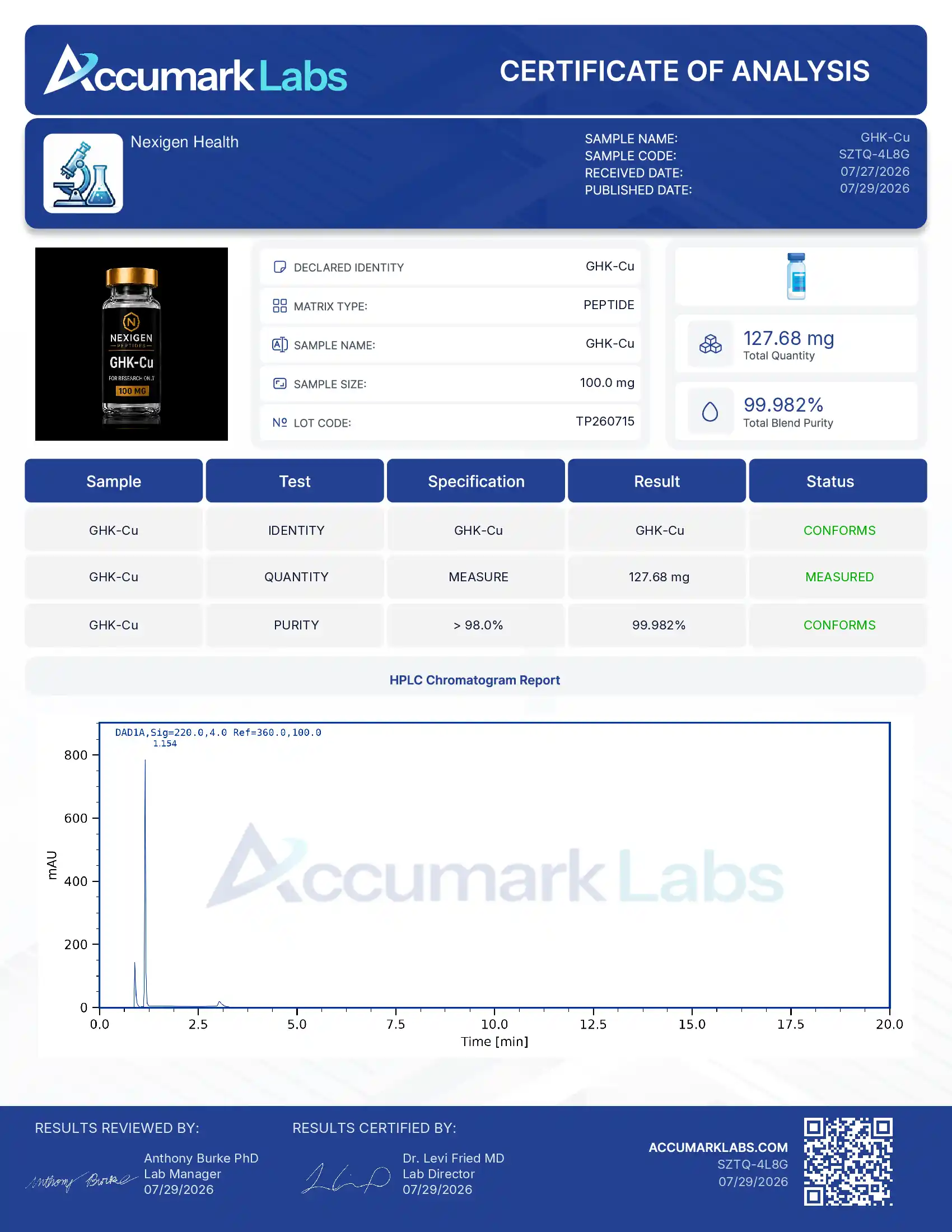
For Nexigen GHK-Cu, researchers should consult the documentation corresponding to the actual production lot.
GHK-Cu FAQ
Is GHK-Cu the same as GHK?
No. GHK is the Gly-His-Lys peptide itself. GHK-Cu describes a copper-associated form of the peptide.
How many amino acids are in GHK?
Three: glycine, histidine and lysine.
What is the GHK sequence?
Gly-His-Lys, abbreviated GHK.
Does GHK-Cu have one universal molecular weight?
Not necessarily. Copper-peptide complexes can be represented in multiple coordination and ionic forms. Researchers should use the identity specified in the applicable product documentation.
Why is histidine important?
Histidine contains an imidazole group capable of participating in copper coordination.
How is GHK-Cu analyzed?
Chromatography, mass spectrometry, spectroscopy and metal-specific analytical methods can provide different types of information.
View GHK-Cu Research Information
GHK vs. GHK-Cu: What is the difference?
Continue the GHK-Cu Research Cluster
View GHK-Cu 100 mg Research Peptide for the product-specific research-material page.
Research Peptides hub · Peptide Research Guide · Peptide Science Library