Wolverine Blend Research Material — Product Overview
Wolverine Blend is a multi-component peptide research formulation supplied by Nexigen Peptides for laboratory, analytical and scientific investigation.
Unlike a single-compound peptide research material, Wolverine Blend contains more than one defined peptide component within a combined research formulation.
Multi-component peptide systems can present different analytical and experimental considerations from single-compound materials. Researchers evaluating a peptide blend should consider formulation identity, lot traceability, analytical characterization, sample preparation and the specific experimental methodology being used.
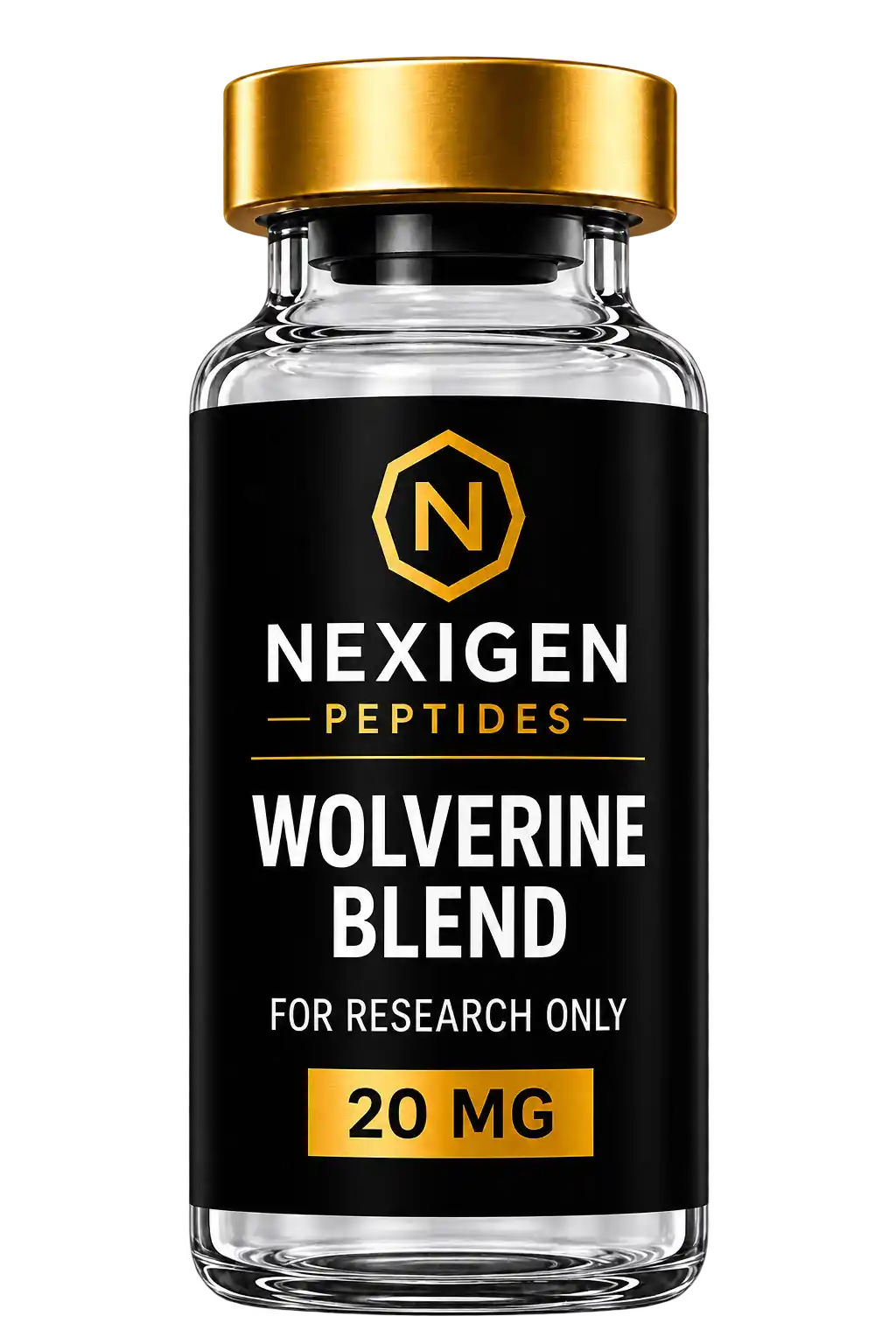
Nexigen Wolverine Blend 20 mg is supplied exclusively as a laboratory research material.
The information on this page is provided to identify the product, explain relevant analytical considerations associated with peptide research blends and provide access to available lot-specific documentation.
This material is intended strictly for laboratory research and is not intended for human or veterinary use or consumption.
Wolverine Blend 20 mg — Research Specifications
| Specification | Information |
|---|---|
| Product Name | Wolverine Blend |
| Quantity | 20 mg total research material |
| Material Type | Multi-component peptide research blend |
| Physical Form | Refer to current product documentation |
| Brand | Nexigen Peptides |
| Lot / Batch | Refer to current product documentation |
| Formulation Identity | Refer to applicable lot documentation |
| Analytical Method | Refer to applicable batch documentation |
| Reported Result | Refer to applicable batch documentation |
| Intended Use | Laboratory research only |
Because Wolverine Blend is a multi-component formulation rather than one standardized chemical compound, the blend should not be assigned one generic CAS number, molecular formula, molecular weight or amino-acid sequence as though the complete formulation were a single molecule.
Researchers should instead use the formulation and analytical information associated with the specific Nexigen lot.
What Is Wolverine Blend?
Wolverine Blend is a branded multi-component peptide research formulation supplied for laboratory and analytical investigation.
The term Wolverine Blend identifies the combined research material rather than a universally standardized single peptide molecule.
For that reason, researchers evaluating Wolverine Blend should rely on the product’s current formulation information and applicable batch documentation rather than assuming that every product carrying a similar commercial name is chemically identical.
Nexigen supplies Wolverine Blend exclusively as a laboratory research peptide blend.
The product is not presented as a medicine, dietary supplement or consumer wellness product.
Is Wolverine Blend a Single Peptide?
No.
Wolverine Blend is a multi-component peptide research formulation, rather than one individual peptide molecule.
This distinction matters scientifically because a single peptide can generally be described using one chemical identity, sequence and molecular mass.
A multi-component formulation must instead be evaluated using information that describes:
- The formulation
- Individual material identity as documented for the lot
- Total quantity
- Batch number
- Analytical testing
- Corresponding research documentation
For reproducible laboratory research, investigators should consult the documentation associated with the specific Wolverine Blend lot being evaluated.
What Is a Research Peptide Blend?
A research peptide blend is a laboratory material containing more than one peptide component within a defined formulation.
Research involving multi-component materials can differ from experiments involving individual peptide compounds because each component may have distinct physicochemical and analytical characteristics.
Researchers evaluating peptide blends may therefore need to consider:
Formulation Identity
The exact research formulation should be defined and traceable to applicable product documentation.
Analytical Separation
Different components may behave differently under chromatographic conditions.
Molecular Identification
Mass-spectrometric or other identity-related analytical approaches may provide information beyond a single chromatographic measurement.
Relative Composition
The analytical strategy should reflect the fact that the sample contains multiple peptide-associated components.
Batch Consistency
Documentation should correspond to the actual production lot rather than a generic formulation claim.
These considerations make analytical documentation particularly important for multi-component peptide research materials.
Wolverine Blend Research Context
Wolverine Blend is a branded laboratory research formulation.
Published peptide literature provides extensive information concerning the analytical characterization of synthetic peptides and peptide mixtures, but scientific findings involving an individual peptide should not automatically be interpreted as findings involving the complete Wolverine Blend formulation.
Similarly, research involving one multi-component peptide system cannot necessarily be generalized to another formulation.
Researchers working with Wolverine Blend should therefore distinguish between research involving an individual peptide and research involving the complete Wolverine Blend formulation.
Unless a scientific publication specifically evaluates the exact formulation under equivalent experimental conditions, results from separate peptide studies should not be represented as demonstrated properties of Wolverine Blend itself.
This distinction improves scientific accuracy and helps researchers interpret published literature appropriately.
Analytical Characterization of Multi-Component Peptide Materials
Multi-component peptide materials can require more detailed analytical evaluation than a simple single-component sample.
Different analytical methods provide different types of information.
Chromatographic Separation
Liquid chromatography can separate components according to their interactions with the chromatographic system.
Modern peptide analysis frequently uses reversed-phase liquid chromatography or related chromatographic techniques to evaluate peptide samples.
Because peptide mixtures contain multiple molecular species, chromatographic conditions can influence which components are resolved and how clearly they can be distinguished.
Published research involving complex peptide mixtures has demonstrated that changes in chromatographic conditions can significantly affect peptide separation and mass-spectrometric response.
Mass Spectrometry
Mass spectrometry can provide molecular information that complements chromatographic analysis.
For multi-component materials, LC-MS can help researchers associate separated chromatographic signals with molecular species.
High-Resolution Mass Spectrometry
High-resolution mass spectrometry can provide additional specificity when researchers need to investigate closely related molecular species or coeluting material.
Recent peptide-analysis research continues to show the value of high-resolution mass spectrometry for identifying peptide-associated impurities that conventional chromatographic measurements may not fully resolve.
Orthogonal Analytical Methods
Modern peptide characterization increasingly relies on multiple complementary techniques rather than one analytical result.
Research into peptide characterization emphasizes the importance of orthogonal analytical methods for assessing peptide identity, physicochemical properties and related impurities.
For researchers evaluating Wolverine Blend, the methods reported in the actual lot documentation are therefore more informative than a generalized company-wide purity statement.
How Should Purity Be Interpreted for a Peptide Blend?
A purity percentage should always be interpreted according to the analytical method used.
This is particularly important for a multi-component research blend.
A chromatographic measurement may describe the relative signals observed under one set of analytical conditions, but it does not automatically establish complete structural identity or characterize every component independently.
Researchers should ask:
- What analytical method generated the result?
- Was the complete formulation analyzed?
- Which lot was tested?
- Were individual molecular identities evaluated?
- Does the documentation correspond to the material currently being supplied?
Modern peptide-characterization research emphasizes that chromatography, mass spectrometry and other analytical techniques can provide complementary information rather than interchangeable measurements.
For that reason, batch-specific analytical results should be interpreted together with the corresponding method and lot information.
Evaluating Wolverine Blend as a Research Peptide Blend
Researchers evaluating Wolverine Blend should consider several factors.
Formulation Identity
The material should correspond to a documented, defined formulation.
Total Quantity
The Nexigen product represented on this page contains 20 mg total research material.
Lot Traceability
The vial or associated documentation should identify the applicable lot or batch.
Analytical Methodology
Researchers should determine which analytical technique was used to characterize the current material.
Batch-Specific Results
Testing associated with one batch should not automatically be assumed to characterize another batch.
Documentation Availability
Available analytical documentation should be easy for research customers to locate and review.
Research-Use Designation
The intended laboratory purpose of the material should be clearly stated.
Nexigen’s objective is to provide research customers with transparent product and lot information so materials can be evaluated using documented analytical evidence.
Wolverine Blend Batch Documentation
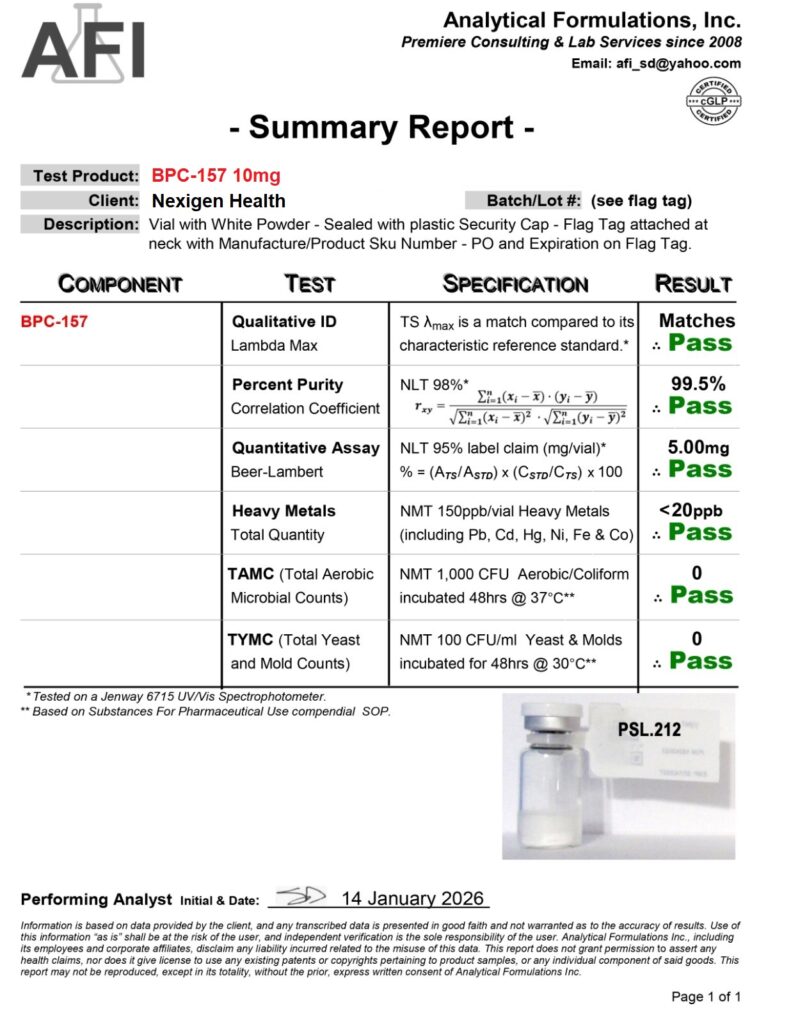
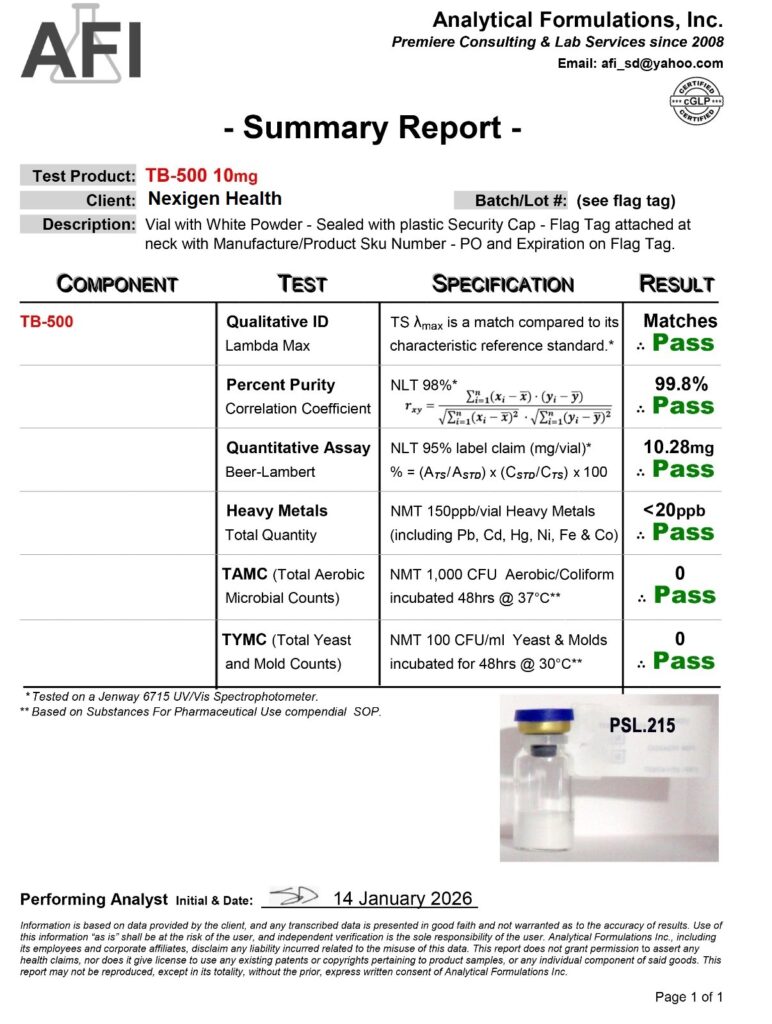
Nexigen Peptides provides available batch-specific documentation associated with its laboratory research materials.
Depending upon the analytical testing completed for a particular Wolverine Blend lot, documentation may include:
- Product identity
- Formulation identification
- Lot or batch number
- Analytical testing date
- Testing methodology
- Reported analytical results
- Identity-related information
- Testing laboratory information
- Original analytical report
Analytical results apply only to the specific material and lot identified in the corresponding documentation.
Why Lot Traceability Matters for Research Peptide Blends
Synthetic peptide materials are manufactured and evaluated in defined production lots.
This is particularly important for multi-component formulations because researchers may need to verify that the material used in an experiment corresponds to the analytical documentation being reviewed.
Lot-specific documentation can help establish:
- Which material was produced
- Which batch was analyzed
- When analysis occurred
- Which analytical methods were used
- What results were reported
- Whether the documentation corresponds to the material being ordered
A generic product name cannot provide this information by itself.
For reproducible laboratory research, product identity and analytical documentation should remain connected to the specific production lot.
Current Developments in Peptide Analytical Research
Peptide analytical science continues to advance rapidly.
Recent research increasingly focuses on improving separation speed, impurity characterization and analytical reproducibility.
High-Resolution Peptide Analysis
Recent research has demonstrated the use of high-resolution mass spectrometry for quantifying peptide-related impurities that may coelute during conventional chromatographic analysis.
LC-HRMS Method Development
Liquid chromatography-high-resolution mass-spectrometry approaches can be used to quantify multiple peptide-related impurities using highly specific analytical workflows.
High-Throughput Peptide Mapping
Recent analytical research has examined tandem-column UHPLC strategies designed to increase peptide-analysis throughput while retaining separation specificity for challenging molecular modifications.
Multi-Method Characterization
Modern peptide research increasingly uses combinations of chromatography, mass spectrometry and complementary analytical techniques to obtain a more complete picture of peptide identity and sample composition.
These advances reinforce the importance of examining the actual analytical methodology associated with a research material rather than relying exclusively on a generalized purity number.
Laboratory Handling
Handling and preparation requirements depend upon the research design, analytical methodology and experimental protocol.
Researchers should follow validated laboratory procedures, applicable scientific literature and available lot-specific documentation when preparing or handling Wolverine Blend research material.
For multi-component peptide formulations, relevant experimental variables can include:
- Sample concentration
- Solution composition
- pH
- Temperature
- Container compatibility
- Analytical methodology
- Sample preparation
- Experiment duration
Nexigen Peptides does not provide human or veterinary preparation, dosing, injection or administration instructions.
Storage of Wolverine Blend Research Material
Store Wolverine Blend according to the conditions specified in the applicable product documentation and available lot-specific analytical records.
Laboratory personnel should use appropriate procedures to minimize unnecessary exposure to moisture, light, temperature fluctuations or other environmental conditions that could affect research-material integrity.
Because a multi-component formulation contains more than one research material, researchers should rely on the storage information associated with the complete lot rather than assuming that generalized guidance for an individual peptide applies to the entire blend.
Where validated lot-specific stability information is available, that documentation should take precedence over generalized storage statements.
Selected References on Peptide Analytical Characterization
Unified Analytical Characterization of Peptide Materials
Researchers developed a multiplex analytical platform integrating multiple chromatographic approaches for comprehensive characterization of peptide quality attributes.
Analytical Chemistry, 2024.
Analytical Considerations for Peptide Characterization
A 2024 review describes the importance of orthogonal analytical methods for peptide identity, structure, impurities and physicochemical characterization.
Analytical Biochemistry, 2024.
PMID: 39089363
High-Resolution MS for Peptide-Related Impurities
A 2025 study demonstrated high-resolution mass-spectrometric quantitation of peptide-related impurities that can be difficult to separate chromatographically.
Journal of the American Society for Mass Spectrometry, 2025.
PMID: 40857144
High-Throughput Peptide Mapping
A 2026 Analytical Chemistry study evaluated tandem-column UHPLC for rapid, high-specificity peptide characterization.
Analytical Chemistry, 2026.
PMID: 42223027
Wolverine Blend Research FAQ
What is Wolverine Blend?
Wolverine Blend is a branded multi-component peptide research formulation supplied by Nexigen Peptides for laboratory, analytical and scientific investigation.
Is Wolverine Blend a peptide?
Wolverine Blend is more accurately described as a peptide research blend because it is a multi-component formulation rather than one individual peptide molecule.
Is Wolverine Blend a standardized chemical compound?
No. Wolverine Blend is a branded research formulation rather than a universally standardized single chemical compound.
Researchers should use the product information and lot-specific documentation associated with the Nexigen formulation being evaluated.
Does Wolverine Blend have one CAS number?
A multi-component peptide formulation should not be assigned one generic CAS number as though the entire blend were a single chemical molecule.
Researchers should consult the applicable product and lot documentation for material-identification information.
Does Wolverine Blend have one molecular weight?
Not in the same sense as a single defined peptide molecule.
Because Wolverine Blend is a multi-component formulation, it should not be represented using one molecular weight for the entire research blend.
How much research material is in Nexigen Wolverine Blend?
The Nexigen Wolverine Blend product represented on this page contains 20 mg total research material.
How is Wolverine Blend evaluated analytically?
Depending upon the analytical objective, peptide research blends may be evaluated using chromatographic, mass-spectrometric or complementary analytical methods.
Different methods provide different information concerning sample composition and molecular identity.
Why is batch documentation important for Wolverine Blend?
Batch documentation connects analytical results to the specific material that was actually produced and tested.
This is particularly important for multi-component research materials because product name alone does not describe all analytical characteristics of a production lot.
Does Nexigen provide a Wolverine Blend Certificate of Analysis?
Available lot-specific analytical documentation may be provided for Nexigen Wolverine Blend research material.
Researchers should verify that the documentation corresponds to the specific lot being evaluated.
Is Wolverine Blend intended for personal use?
No.
Nexigen Wolverine Blend is supplied exclusively for legitimate laboratory, analytical and scientific research and is not intended for human or veterinary use or consumption.
Does Nexigen provide Wolverine Blend dosing instructions?
No.
Nexigen Peptides does not provide human or veterinary dosing recommendations, injection instructions, administration guidance or treatment protocols.
Does Nexigen provide a Wolverine Blend protocol?
Nexigen does not provide human or veterinary administration protocols. Experimental laboratory procedures depend upon the research model, analytical methodology and validated protocol selected by the researcher.
Research Use Only
Nexigen Wolverine Blend 20 mg is supplied exclusively for legitimate laboratory, analytical and scientific research.
This research material is not intended for human or veterinary use or consumption, clinical use, diagnosis, treatment, cure or prevention of disease.
Nexigen Peptides does not provide medical advice, human or veterinary dosing recommendations, injection instructions, administration guidance or personal-use protocols.