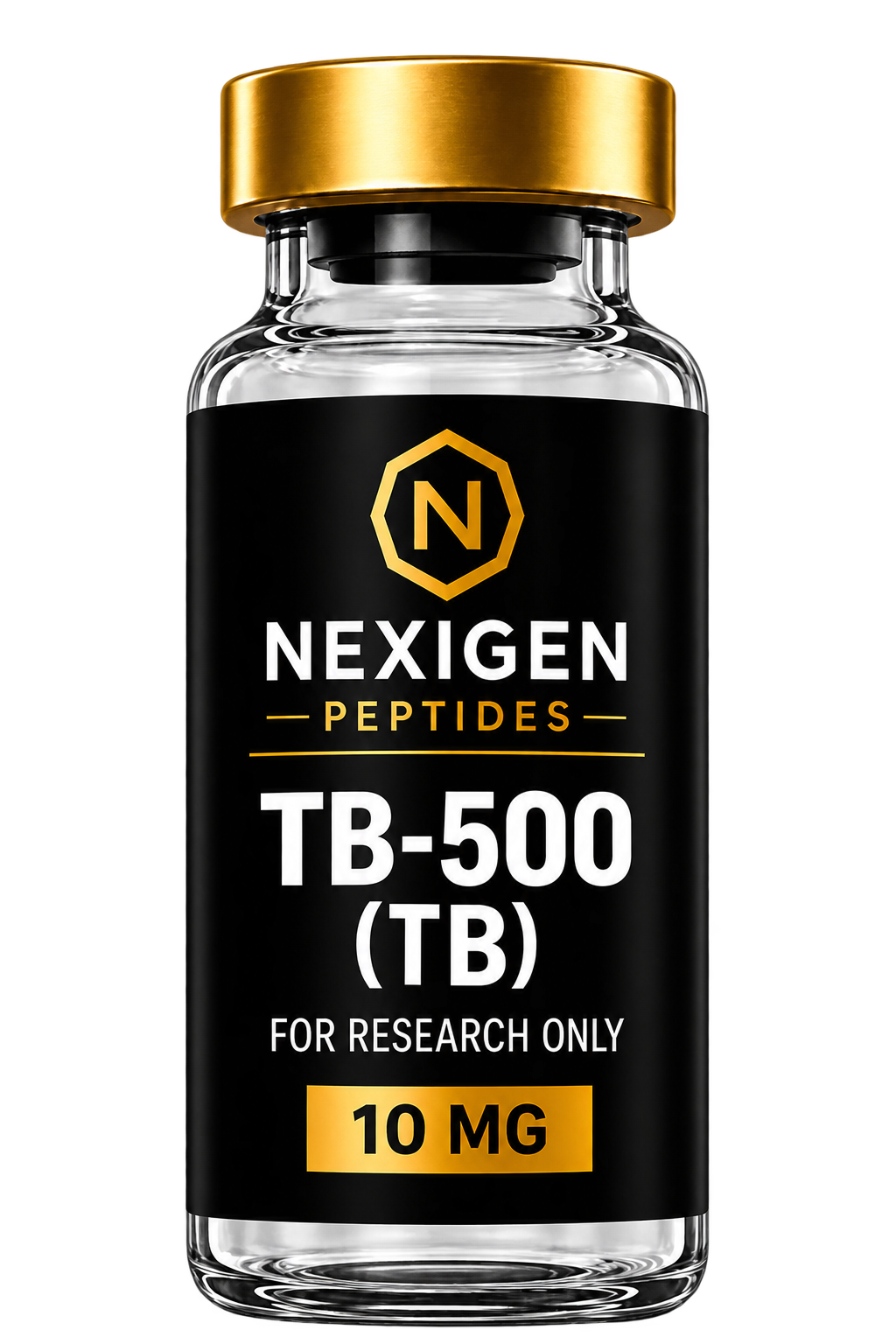
Quick answer: TB-500 (TB4) 10 mg Research Peptide is presented by Nexigen as a research peptide for legitimate laboratory, analytical and scientific research. This page provides product-specific research context and links to related Nexigen research resources.
TB-500 10 mg Research Peptide — Product Overview
TB-500 is a peptide research material commonly discussed within the broader scientific literature surrounding thymosin beta-4-related peptides. Nexigen TB-500 (TB) 10 mg is supplied as a defined research material for controlled laboratory, analytical and scientific investigation.
Research involving TB-500 requires careful attention to material identity because the term TB-500 has not always been used consistently across scientific publications, analytical reports and commercially supplied materials. Researchers should therefore distinguish the specific material being evaluated from broader thymosin beta-4 terminology when interpreting experimental results. Published literature has likewise identified variability in the way TB-500 materials are described and characterized. PubMed
Quick answer: TB-500 is a thymosin-beta-4-related peptide research material used in controlled laboratory studies involving peptide identity, molecular characteristics, analytical verification and related biochemical research systems.
TB-500 Research Specifications
| Specification | Information |
|---|---|
| Research Material | TB-500 (TB) |
| Quantity | 10 mg |
| Material Category | Thymosin-beta-4-related peptide research material |
| Research Focus | Molecular, biochemical and analytical investigation |
| Supplier | Nexigen Peptides |
| Intended Context | Laboratory, analytical and scientific research |
What Is TB-500?
TB-500 is a name used within peptide research for materials associated with the thymosin beta-4 research family. Thymosin beta-4 itself is a well-characterized peptide that has been extensively studied in relation to actin-associated molecular systems and other cellular processes. PubMed
Researchers should not assume that every material identified commercially as TB-500 is chemically identical to full-length thymosin beta-4 or to materials described under the same name in another publication. Exact sequence, molecular identity and material form are important variables when comparing data.
TB-500 Research Context
Molecular Identity and Nomenclature
A fundamental consideration in TB-500 research is material identity. Experimental interpretation should begin by confirming which peptide material was evaluated, how it was characterized and whether the terminology used in one study corresponds to the material used in another.
This distinction is particularly important for literature searches because scientific databases may reference:
TB-500, TB500, thymosin beta-4, Tβ4, or thymosin-beta-4-related peptides.
These terms should not automatically be treated as interchangeable.
Peptide Structure and Molecular Characterization
Peptide research commonly evaluates molecular characteristics such as:
- peptide identity
- molecular mass
- sequence characteristics
- chromatographic behavior
- interaction with molecular targets
- stability under defined experimental conditions
- comparison with analytical reference material
Thymosin beta-4 research has extensively examined its molecular interaction with actin and related cellular systems, providing a broader scientific framework for research involving thymosin-beta-4-related peptides. PubMed
Analytical Evaluation of TB-500
Depending on the research question and available methodology, peptide materials may be evaluated using techniques such as:
High-performance liquid chromatography (HPLC) for chromatographic profiling and purity assessment.
Liquid chromatography-mass spectrometry (LC-MS) for molecular-mass and identity-related analysis.
Mass spectrometry for molecular characterization and peptide identification.
Reference comparison for evaluating whether observed analytical characteristics correspond to an expected research material.
No single analytical method answers every question about peptide identity or composition. Orthogonal analytical techniques can provide complementary information.
Interpreting TB-500 Research
Results involving TB-500 should be interpreted according to the exact experimental system used.
Important variables include:
Material identity — Confirm what peptide was actually evaluated.
Concentration and experimental conditions — Molecular behavior can vary substantially with study design.
Analytical method — Different techniques evaluate different properties of the material.
Experimental model — Findings from one model should not automatically be generalized to another.
Reference terminology — TB-500 and thymosin beta-4 terminology should be checked carefully before comparing studies.
This approach helps researchers distinguish direct experimental evidence from assumptions based solely on product or compound naming.
Laboratory Handling and Storage
TB-500 research material should be handled according to validated laboratory procedures appropriate to the material form and analytical method being used.
Storage conditions, stability periods and experimental preparation requirements should be based on material-specific information and established laboratory protocols rather than generalized peptide assumptions.
TB-500 Research FAQ
What is TB-500?
TB-500 is a thymosin-beta-4-related peptide research material used in controlled laboratory, molecular and analytical investigation.
Is TB-500 the same as thymosin beta-4?
The terminology is not always used consistently. Researchers should verify the precise material identity rather than assuming TB-500 and full-length thymosin beta-4 are identical in every source or experiment.
What quantity does Nexigen supply?
This Nexigen research product contains 10 mg of TB-500 research material.
What types of research can involve TB-500?
Research may involve peptide identity, molecular characterization, biochemical interactions, analytical methodology, peptide stability and comparison of thymosin-beta-4-related research materials.
How should TB-500 studies be compared?
Researchers should compare material identity, experimental model, concentration, analytical methodology, endpoints and study conditions before treating results from separate experiments as equivalent.
What analytical methods can be used to evaluate peptide research materials?
Depending on the research objective, methods may include HPLC, LC-MS, mass spectrometry and other validated analytical techniques.
Research-Use Statement
Nexigen TB-500 (TB) 10 mg is supplied exclusively as a laboratory, analytical and scientific research material.
TB-500 (TB4) Research at a Glance
Quick Answer
TB-500 (TB4) 10 mg Research Peptide is presented by Nexigen as a research peptide for legitimate laboratory, analytical and scientific research.
Key Facts
- Research material: TB-500 (TB4)
- Page type: Product-specific research material page
- Related research resources: 0
- Aliases/search terms: tb 500 tb4
Evidence Interpretation
Research findings linked from this page may come from biochemical, cellular, animal or human studies depending on the compound. Those evidence levels answer different questions and should not be treated as interchangeable.
What This Page Does Not Establish
This page does not establish human or veterinary safety, efficacy, dosing, administration or a clinical indication. Nexigen does not provide personal-use guidance.