FREE 2–3 DAY U.S. SHIPPING ON QUALIFYING RESEARCH ORDERS OVER $99

LABORATORY RESEARCH MATERIAL

Glow Blend 70 mg Research Peptide Blend

$120.00

LABORATORY RESEARCH MATERIAL

Glow Blend is a defined multi-component peptide research formulation supplied for controlled laboratory, analytical and scientific investigation.

Nexigen Glow Blend 70 mg is provided exclusively as a research-use-only material. Researchers can review product information and available lot-specific analytical documentation associated with the formulation.

FOR LABORATORY RESEARCH ONLY. NOT FOR HUMAN, VETERINARY, COSMETIC OR PERSONAL USE.

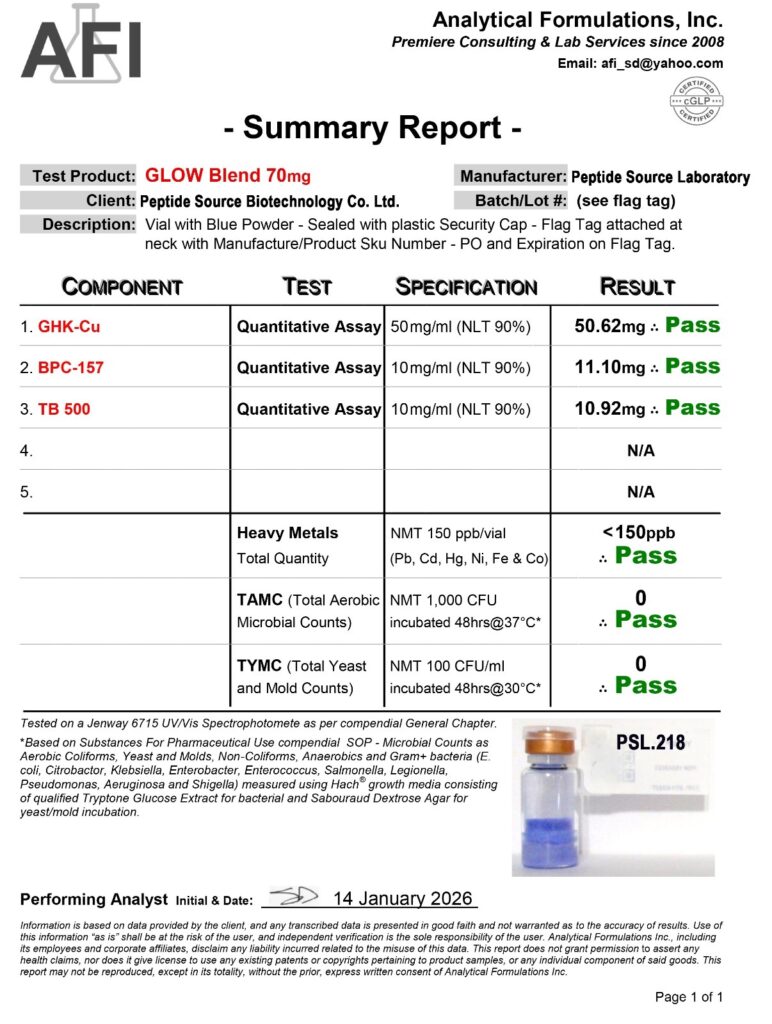
view test results

Glow Blend Research Material — Product Overview

Glow Blend is a branded multi-component peptide research formulation supplied by Nexigen Peptides for laboratory, analytical and scientific investigation.

Unlike an individual peptide compound, Glow Blend represents a defined formulation containing multiple peptide-associated research materials within the same product.

Multi-component peptide systems can present analytical considerations that differ from those associated with single-compound materials. Researchers evaluating a peptide blend should therefore consider formulation identity, lot traceability, analytical methodology, batch-specific documentation and the requirements of the intended experimental system.

Nexigen Glow Blend 70 mg is supplied exclusively as a laboratory research material.

The information on this page is provided to identify the product, describe relevant scientific and analytical considerations associated with peptide research blends and provide access to available lot-specific documentation.

The Glow Blend name is a Nexigen product designation and should not be interpreted as a claim regarding cosmetic appearance or physiological effects.

This material is intended strictly for laboratory research and is not intended for human, veterinary, cosmetic or personal use.

Glow Blend 70 mg — Research Specifications

Specification Information
Product Name Glow Blend
Quantity 70 mg total research material
Material Type Multi-component peptide research blend
Physical Form Refer to current product documentation
Brand Nexigen Peptides
Lot / Batch Refer to current lot documentation
Formulation Identity Refer to applicable batch documentation
Analytical Method Refer to applicable batch documentation
Reported Analytical Result Refer to current batch documentation
Intended Use Laboratory research only

Glow Blend is a multi-component research formulation rather than one standardized chemical molecule.

Accordingly, the complete formulation should not be assigned one generic CAS number, molecular formula, molecular weight or amino-acid sequence as though Glow Blend were one individual peptide.

Researchers should instead rely upon the formulation information and analytical documentation associated with the specific Nexigen production lot.

What Is Glow Blend?

Glow Blend is a branded multi-component peptide research formulation supplied by Nexigen Peptides for laboratory, analytical and scientific investigation.

The name Glow Blend identifies the complete Nexigen research formulation rather than a universally standardized single peptide molecule.

Branded peptide blends can vary between suppliers. Researchers therefore should not assume that products marketed under similar names are chemically identical or have equivalent analytical characteristics.

For reproducible scientific work, investigators should rely on the product information and lot-specific documentation associated with the actual Glow Blend material being evaluated.

Nexigen supplies Glow Blend exclusively as a laboratory research peptide blend.

What Does the Name “Glow Blend” Mean?

Glow Blend is the branded product name used by Nexigen Peptides for this defined laboratory research formulation.

The product name itself should not be interpreted as evidence of a cosmetic, dermatological, anti-aging, appearance-related or other physiological effect.

In scientific and analytical contexts, the material should be evaluated according to its:

  • Formulation identity
  • Production lot
  • Analytical documentation
  • Material characteristics
  • Experimental protocol

Rather than assumptions based on the commercial product name.

This distinction is especially important for branded research materials because a brand name does not define the molecular characteristics or experimental behavior of the material.

Is Glow Blend a Single Peptide?

No.

Glow Blend is a multi-component peptide research formulation, not one individual peptide molecule.

A single peptide can generally be described using one defined molecular structure, sequence, molecular weight and chemical identifier.

A multi-component formulation instead needs to be evaluated using information concerning:

  • Formulation identity
  • Total material quantity
  • Individual lot identity
  • Analytical methodology
  • Batch-specific results
  • Formulation documentation

Researchers should therefore use the analytical information corresponding to the specific Glow Blend lot rather than attempting to characterize the complete formulation using one molecular identifier.

What Is a Research Peptide Blend?

A research peptide blend is a laboratory material containing multiple peptide components within a defined formulation.

Multi-component research materials can present additional analytical considerations because different molecular species may exhibit different:

  • Chromatographic retention behavior
  • Ionization properties
  • Molecular masses
  • Degradation pathways
  • Detector responses
  • Physicochemical characteristics

This means the analysis of a peptide mixture may require more than one analytical technique.

Modern peptide analytical science increasingly uses combinations of chromatography and mass spectrometry to characterize complex peptide samples and peptide-related impurities.

Glow Blend Research Context

Glow Blend is a branded laboratory research formulation.

Scientific literature provides extensive information regarding synthetic peptide chemistry, peptide mixtures, chromatographic characterization, mass-spectrometric analysis and peptide stability.

However, research findings involving an individual peptide should not automatically be attributed to the complete Glow Blend formulation.

Researchers should distinguish between research involving an individual peptide material and research involving the complete Glow Blend formulation.

Unless a scientific publication specifically examines the same formulation under comparable experimental conditions, results involving other peptide materials should not be presented as demonstrated characteristics of Glow Blend itself.

This distinction supports scientifically appropriate interpretation of research literature and helps prevent findings from unrelated experimental systems from being generalized incorrectly.

Analytical Characterization of Multi-Component Peptide Research Materials

Analytical characterization can be particularly important when evaluating a multi-component peptide material.

Different analytical techniques answer different scientific questions.

High-Performance Liquid Chromatography

High-performance liquid chromatography, commonly abbreviated HPLC, can separate components according to their interactions with the chromatographic system.

For a peptide blend, different molecular species can produce separate chromatographic signals.

The resulting profile may depend upon:

  • Column chemistry
  • Mobile phase
  • Solvent gradient
  • Sample concentration
  • Temperature
  • Detector configuration

Ultra-High-Performance Liquid Chromatography

UHPLC uses high-pressure chromatographic systems capable of providing efficient separations under appropriate analytical conditions.

Recent research continues to improve peptide-analysis throughput, including tandem-column UHPLC workflows designed to increase analysis speed while preserving analytical specificity.

Mass Spectrometry

Mass spectrometry provides molecular information that complements chromatographic separation.

For a multi-component material, LC-MS can help researchers associate chromatographic signals with molecular species.

High-Resolution Mass Spectrometry

High-resolution mass spectrometry can provide additional specificity when closely related molecular species or low-level impurities are difficult to distinguish.

Recent research has demonstrated the use of high-resolution MS to quantify peptide-related impurities that may coelute during conventional chromatographic analysis.

Orthogonal Analytical Characterization

Modern peptide characterization frequently uses multiple complementary analytical approaches.

Research into peptide characterization emphasizes the importance of orthogonal analytical techniques for evaluating peptide identity, physicochemical characteristics and related impurities.

For Glow Blend, the methods reported in the actual lot documentation are therefore more informative than a generalized marketing statement about purity.

How Should Purity Be Interpreted for a Research Peptide Blend?

A purity percentage should always be interpreted in the context of the analytical method that generated it.

This becomes especially important for a multi-component formulation.

A chromatographic result may describe the relative detector signals observed under one analytical condition, but it does not necessarily establish:

  • Complete formulation identity
  • Structural identity of every component
  • Quantitative composition of every component
  • Absence of coeluting material
  • Absence of degradation-related species

Research into peptide analysis has emphasized that detector response and analytical methodology can materially affect interpretation of peptide impurity measurements.

For that reason, lot-specific analytical information should be prioritized over a permanent generic purity claim unless that claim is analytically meaningful for the entire formulation and supported by current documentation.

Evaluating Glow Blend as a Research Peptide Blend

Researchers evaluating Glow Blend should consider several factors.

Formulation Identity

The research material should correspond to a defined and documented formulation.

Total Quantity

The Nexigen product represented on this page contains 70 mg total research material.

Lot Traceability

Researchers should be able to identify the production lot associated with the material.

Analytical Methodology

Available documentation should identify the analytical methods used whenever possible.

Batch-Specific Results

An analytical result associated with one production lot should not automatically be assumed to characterize another.

Documentation Availability

Certificates of Analysis or applicable analytical reports should be accessible to research customers wherever available.

Research-Use Designation

The intended laboratory use of the material should be clearly identified.

Nexigen’s objective is to provide research customers with transparent product information and access to available lot-specific analytical documentation.

Glow Blend Batch Documentation

Nexigen Peptides provides available lot-specific analytical documentation associated with its laboratory research materials.

Depending upon the analytical testing performed for a particular Glow Blend lot, documentation may include:

  • Product identification
  • Formulation identification
  • Lot or batch number
  • Analytical testing date
  • Analytical methodology
  • Reported analytical results
  • Identity-related information
  • Testing laboratory information
  • Original analytical report

Analytical results apply only to the specific material and production lot identified in the corresponding documentation.

Why Lot Traceability Matters for Peptide Research Blends

The name of a research product does not identify the particular production batch that was analyzed.

Lot traceability connects the material being evaluated with its analytical records.

Batch-specific documentation may help researchers determine:

  • Which material was produced
  • Which lot was analyzed
  • When testing occurred
  • Which analytical methods were used
  • What results were reported
  • Whether the report corresponds to the material currently being supplied

This becomes particularly important for multi-component research formulations because their analytical profiles can be more complex than those of single-compound materials.

For reproducible research, product identity, lot identity and analytical documentation should remain connected.

Current Developments in Peptide Analytical Research

Peptide analytical science continues to become more sensitive, specific and efficient.

LC-HRMS Impurity Analysis

LC-HRMS methods can support quantitative analysis of multiple peptide-related impurities with high specificity and sensitivity.

Coeluting Peptide Impurities

High-resolution mass spectrometry can help quantify low-abundance peptide-related impurities that conventional reversed-phase HPLC may not fully separate.

Peptide Impurity Quantification

Research has highlighted the importance of detector response and relative response factors when interpreting peptide impurity measurements produced by HPLC with UV detection.

High-Throughput Peptide Analysis

Recent analytical research has examined tandem-column UHPLC workflows capable of increasing peptide-analysis throughput while maintaining specificity for difficult molecular modifications.

Analytical Method Transferability

Research into peptide separation has also examined the challenges involved in transferring methods between analytical and preparative chromatographic systems, reinforcing the importance of method-specific conditions in peptide characterization.

These developments demonstrate why researchers should evaluate the actual analytical methodology and lot-specific results associated with a research material rather than relying exclusively on a generalized purity statement.

Laboratory Handling

Handling and preparation requirements depend upon the research design, analytical methodology and experimental protocol.

Researchers should follow validated laboratory procedures, applicable scientific literature and available lot-specific documentation when preparing or handling Glow Blend research material.

For multi-component peptide formulations, experimental variables may include:

  • Material concentration
  • Solution composition
  • pH
  • Temperature
  • Container compatibility
  • Sample preparation
  • Analytical methodology
  • Duration of experimental exposure

Nexigen Peptides does not provide human, veterinary, cosmetic or personal-use preparation, dosing, injection or administration instructions.

Storage of Glow Blend Research Material

Store Glow Blend according to the conditions specified in the applicable product documentation and available lot-specific analytical records.

Laboratory personnel should use appropriate procedures to minimize unnecessary exposure to moisture, light, temperature fluctuations or other environmental conditions that could affect research-material integrity.

Because Glow Blend is a multi-component formulation, researchers should rely upon storage information associated with the complete material rather than assuming that generalized guidance for an individual peptide applies to the entire formulation.

Where validated lot-specific stability information is available, that documentation should take precedence over generalized storage recommendations.

Selected References on Peptide Analytical Characterization

Validation of LC-HRMS for Peptide-Related Impurity Analysis

FDA-affiliated researchers validated a liquid chromatography-high-resolution mass-spectrometry approach capable of quantitatively analyzing multiple peptide-related impurities.

Journal of Pharmaceutical and Biomedical Analysis, 2025.
PMID: 39778260

High-Resolution Mass Spectrometry of Coeluting Peptide Impurities

A 2025 study demonstrated the use of high-resolution MS to quantify peptide-associated impurities that conventional chromatography could not fully separate.

Journal of the American Society for Mass Spectrometry, 2025.
PMID: 40857144

Analytical Considerations for Peptide Characterization

A review discusses peptide identity, physicochemical characterization, impurity analysis and the importance of complementary analytical methodologies.

PMID: 39089363

High-Throughput Peptide Mapping Using Tandem-Column UHPLC

A 2026 study demonstrated a substantially faster UHPLC peptide-analysis workflow while maintaining analytical specificity.

Analytical Chemistry, 2026.
PMID: 42223027

Glow Blend Research FAQ

What is Glow Blend?

Glow Blend is a branded multi-component peptide research formulation supplied by Nexigen Peptides for laboratory, analytical and scientific investigation.

Is Glow Blend a research peptide?

Glow Blend is more accurately described as a research peptide blend because it is a multi-component formulation rather than one individual peptide molecule.

What does the name Glow Blend mean?

Glow Blend is the branded name used by Nexigen Peptides for this laboratory research formulation.

The name does not represent a claim concerning cosmetic appearance, skin, hair, rejuvenation or any other physiological outcome.

Is Glow Blend a cosmetic product?

No.

Nexigen Glow Blend is supplied as a laboratory research material and is not intended for cosmetic, human, veterinary or personal use.

Is Glow Blend a standardized chemical compound?

No.

Glow Blend is a branded multi-component research formulation rather than one universally standardized single chemical compound.

Researchers should use the current Nexigen product and lot documentation when evaluating the material.

How much material is in Nexigen Glow Blend?

The product described on this page contains 70 mg total research material.

Does Glow Blend have one CAS number?

A multi-component peptide formulation should not be assigned one generic CAS number as though the complete blend were one chemical molecule.

Researchers should consult the applicable product and lot documentation for material-identification information.

Does Glow Blend have one molecular weight?

Not in the same way as one defined peptide molecule.

Because Glow Blend is a multi-component formulation, one molecular weight should not be assigned to the complete material as though it were a single chemical entity.

How can Glow Blend be evaluated analytically?

Depending upon the research objective, analytical approaches may include liquid chromatography, high-resolution mass spectrometry and other complementary analytical methods.

Different methods provide different information concerning sample composition and molecular identity.

Why is batch documentation important for Glow Blend?

Batch documentation connects analytical results to the actual research material that was produced and tested.

This is particularly important for multi-component formulations because the product name alone does not provide complete analytical characterization.

Does Nexigen provide Glow Blend batch documentation?

Available lot-specific analytical documentation may be provided for Nexigen Glow Blend research material.

Researchers should confirm that documentation corresponds to the specific lot being evaluated.

Is Glow Blend intended for personal use?

No.

Nexigen Glow Blend is supplied exclusively for legitimate laboratory, analytical and scientific research.

It is not intended for human, veterinary, cosmetic or personal use.

Does Nexigen provide Glow Blend dosing instructions?

No.

Nexigen Peptides does not provide human or veterinary dosing recommendations, injection instructions, administration guidance, cosmetic-use instructions or treatment protocols.

Does Nexigen provide a Glow Blend protocol?

Nexigen provides research-material information and available analytical documentation.

Laboratory procedures depend on the experimental model, analytical methodology and validated protocol selected by the researcher.

Research Use Only

Nexigen Glow Blend 70 mg is supplied exclusively for legitimate laboratory, analytical and scientific research.

The Glow Blend name is a product designation and is not a representation of cosmetic, appearance-related or physiological effects.

This research material is not intended for human, veterinary, cosmetic or personal use or consumption, clinical use, diagnosis, treatment, cure or prevention of disease.

Nexigen Peptides does not provide medical advice, cosmetic-use instructions, human or veterinary dosing recommendations, injection instructions, administration guidance or personal-use protocols.

Glow Blend 70 mg Research Peptide Blend is supplied by Nexigen Peptides as a research-use-only material for laboratory, analytical and scientific investigation. The information on this page identifies the material, summarizes relevant scientific context and provides access to available batch documentation. Not intended for human or veterinary use or consumption.
Verified Lab Testing

Certificate of Analysis

Verified Lab Testing

Certificate of Analysis

Welcome to

Nexigen Peptides

All products sold by Nexigen Peptides are intended for laboratory and research purposes only. They are not for human consumption, veterinary use, or medical applications. You must be 21 years or older to purchase. Misuse of these products is strictly prohibited.

You must be 21 or older to access this site.