How Is MOTS-c Research Material Evaluated?
MOTS-c is a defined 16-amino-acid synthetic peptide.
That gives researchers a known molecular reference against which analytical testing can be performed.
However, no single laboratory result fully answers every question about a peptide sample.
Analytical evaluation commonly separates several questions:
- Is the expected molecular material present?
- What does the chromatographic profile look like?
- Are additional molecular species detectable?
- How much target material is present?
- What material form is represented?
- Does the analytical report correspond to the actual production lot?
Synthetic-peptide quality characterization commonly integrates chromatographic and mass-spectrometric techniques because the methods provide complementary information.
MOTS-c Analytical Reference
The recognized MOTS-c sequence is:
MRWQEMGYIFYPRKLR
PubChem reports:
| Property | Reference |
|---|---|
| Sequence Length | 16 amino acids |
| Formula | C101H152N28O22S2 |
| Molecular Weight | ~2174.6 g/mol |
| CAS | 1627580-64-6 |
| PubChem CID | 146675088 |
These values provide useful reference information, but actual lot analysis must correspond to the material form documented for that lot.
HPLC Analysis of MOTS-c
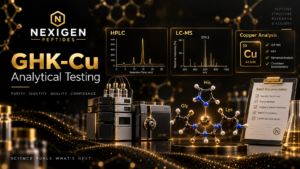
High-performance liquid chromatography, or HPLC, is widely used for peptide separation and characterization.
In an HPLC experiment, sample components interact differently with a stationary phase and mobile phase.
As a result, compounds can separate and appear as different chromatographic peaks.
HPLC has long been used extensively for peptide isolation, purification and analytical characterization.
For MOTS-c research material, HPLC may provide information concerning:
- chromatographic profile
- relative peak areas
- presence of detectable impurities
- retention behavior
- batch-to-batch consistency
A Purity Percentage Requires Context
A statement such as:
“99% purity”
is incomplete without analytical context.
Researchers should ideally know:
- analytical method
- column
- detector
- wavelength
- mobile phases
- gradient
- integration rules
- sample concentration
- date of analysis
- lot number
Peptide chromatography can be strongly influenced by method conditions. Modern reviews emphasize that peptide separation and recovery can vary according to chromatographic parameters and molecular characteristics.
Therefore, purity figures from unrelated laboratories or methods may not be directly comparable.
What HPLC Does Not Prove by Itself
A prominent chromatographic peak does not automatically establish molecular identity.
HPLC primarily addresses separation and relative chromatographic composition.
A peak appearing at a particular retention time does not independently prove:
“This molecule is definitely MOTS-c.”
That is why peptide quality evaluation often combines HPLC with techniques capable of providing molecular information.
LC-MS and MOTS-c Identity
Liquid chromatography-mass spectrometry combines chromatographic separation with measurement of molecular ions.
For synthetic peptides, mass spectrometry is particularly useful because the expected sequence is already known.
This allows measured molecular information to be compared with the expected peptide identity.
A 2024 methods publication describes MS as a major method for evaluating authenticity and integrity of synthetic peptides and discusses both LC-MS and MALDI-TOF approaches.
Understanding Molecular Mass
PubChem reports a molecular weight of approximately:
2174.6 g/mol
for its MOTS-c representation.
Researchers should not necessarily expect an LC-MS instrument to display one simple peak labeled 2174.6.
Mass spectra can contain:
- singly charged ions
- multiply charged ions
- isotopic envelopes
- adducts
- fragments
- counterion-associated species
Proper interpretation requires knowledge of ionization conditions and the expected material.
LC-MS Can Help Characterize Impurities
Synthetic peptide production can generate structurally related impurities.
Potential examples may include:
- truncated sequences
- deletion products
- insertion-related species
- oxidation
- epimerization
- incomplete synthesis products
- degradation products
LC-MS is widely used to characterize synthetic-peptide impurities because it combines separation with molecular-mass information.
This is particularly useful when an impurity is structurally similar to the intended peptide.
Identity, Purity and Quantity Are Different Measurements
These three concepts should remain separate.
| Question | Analytical objective |
|---|---|
| Identity | Is the material consistent with MOTS-c? |
| Purity | What does the chromatographic composition show? |
| Quantity | How much target material is actually present? |
A fourth question is also important:
| Question | Analytical objective |
|---|---|
| Material Form | Which peptide/counterion or associated form is documented? |
One result does not necessarily answer all four questions.
Reference-standard research in synthetic peptides similarly emphasizes integration of multiple analytical methods for identity, purity and strength.
MOTS-c Sequence Verification
MOTS-c has the expected sequence:
MRWQEMGYIFYPRKLR
Sequence-related characterization can therefore compare analytical evidence with a defined expected molecular structure.
For a commercial research material, researchers should verify that the sequence information on the product page, research information and analytical report is consistent.
Material Form Considerations
Material form deserves particular attention.
Public databases may include synonyms involving specific counterion or salt representations.
PubChem’s MOTS-c record includes depositor-supplied terminology referring to a trifluoroacetate-associated material among its synonyms.
That does not mean every MOTS-c research vial universally contains the identical associated form.
The actual Nexigen lot documentation should control the representation used for a specific material.
Why Orthogonal Testing Is Valuable
Orthogonal testing means evaluating a material using methods that provide different types of information.
For example:
HPLC
provides chromatographic separation information.
Mass spectrometry
provides molecular mass-related evidence.
Amino-acid analysis
can provide compositional and quantitative information.
Other specialized techniques
may address specific impurities, stereochemical questions or material properties.
Amino-acid analysis used alongside MS and chromatographic techniques has historically been recognized as a useful component of comprehensive synthetic-peptide characterization.
Why One Chromatogram Is Not the Entire COA
A scientifically useful Certificate of Analysis should connect the analytical result with a specific lot.
For MOTS-c, Nexigen should ideally present:
| COA Field | Information |
|---|---|
| Material | MOTS-c |
| Sequence | MRWQEMGYIFYPRKLR |
| Lot Number | Actual production lot |
| Material Form | Actual documented form |
| Test Date | Actual date |
| Laboratory | Actual testing laboratory |
| HPLC Method | Actual method |
| HPLC Result | Actual result |
| Identity Method | Actual method |
| Identity Result | Actual result |
| Quantity | If tested |
| Supporting Report | Original document |
This makes analytical information traceable rather than simply promotional.
Why Batch-Specific Documentation Matters
A peptide product may be manufactured in multiple lots.
Analytical evidence from one lot should not automatically be presented as evidence for another lot.
The useful relationship is:
product → lot → test → result → original report
rather than:
product → generic purity claim.
This is especially important for Nexigen because batch-specific analytical information can become a genuine first-party information asset for both scientific users and search systems.
Chromatographic Impurities Can Be Complex
Synthetic-peptide impurity analysis is not trivial.
Some impurities may differ from the target peptide by:
- one residue
- stereochemistry
- oxidation state
- sequence truncation
- structural modification
Some closely related species can even coelute under particular chromatographic conditions.
Research on peptide quality control has therefore explored multidimensional chromatography and LC-MS approaches to better distinguish structurally similar impurities.
Why Sequence and Lot Information Should Be Public
A research-material page becomes more scientifically useful when it gives researchers enough information to identify the intended molecular entity.
For MOTS-c that includes:
Name: MOTS-c
Sequence: MRWQEMGYIFYPRKLR
CAS: 1627580-64-6
PubChem CID: 146675088
MW reference: approximately 2174.6 g/mol
Lot: specific current production lot
Analytical documentation: corresponding lot-specific reports
This information allows the product page to operate as more than an ecommerce listing.
It becomes a structured research-material record.
Evaluating an MOTS-c COA
When reviewing MOTS-c documentation, researchers should ask:
Does the lot number match?
The report should correspond to the actual material.
Does the identity test support MOTS-c?
Check the analytical method and reported identity result.
What does the HPLC result actually measure?
Look for method information rather than only a percentage.
Is the material form identified?
Counterion or associated form information can affect molecular interpretation.
Is the original report available?
The underlying laboratory document provides stronger evidence than a marketing transcription.
Analytical Testing and Scientific Reproducibility
Experimental research depends on knowing what material was actually used.
For synthetic peptides, analytical uncertainty can introduce another source of experimental variability.
Clear sequence information, lot traceability and accessible testing documentation therefore support reproducible research.
Selected Scientific References
PubChem CID 146675088 — MOTS-c molecular identity.
Characterization of Synthetic Peptides by Mass Spectrometry.
Characterization of Synthetic Peptide Therapeutics Using LC-MS.
Reference Standards to Support Quality of Synthetic Peptide Therapeutics.
Related MOTS-c Resources
Link this article to:
- MOTS-c 10 mg Research Peptide
- What Is MOTS-c?
- MOTS-c Sequence, Structure and Molecular Characteristics
- MOTS-c Research in 2026
FOR LABORATORY RESEARCH ONLY. NOT FOR HUMAN OR VETERINARY USE OR CONSUMPTION.
Continue the MOTS-c Research Cluster
View MOTS-c 10 mg Research Peptide for the product-specific research-material page.