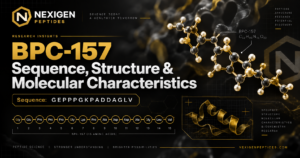
BPC-157 is a synthetic peptide containing 15 amino-acid residues with the sequence GEPPPGKPADDAGLV. It is commonly described as a pentadecapeptide and appears in scientific databases under names including BPC-157, BPC 157 and Bepecin.
PubChem assigns BPC-157 CID 9941957, CAS 137525-51-0, molecular formula C62H98N16O22, and molecular weight approximately 1419.5 g/mol.
BPC-157 at a Glance
| Attribute | Information |
|---|---|
| Name | BPC-157 |
| Synonyms | BPC 157, BPC157, Bepecin |
| Compound class | Pentadecapeptide |
| Amino acids | 15 |
| Sequence | GEPPPGKPADDAGLV |
| CAS | 137525-51-0 |
| Formula | C62H98N16O22 |
| Molecular weight | ~1419.5 g/mol |
| PubChem CID | 9941957 |
Why Is BPC-157 Called a Pentadecapeptide?
The prefix penta-deca refers to fifteen.
Peptides are chains of amino-acid residues connected through peptide bonds. Because BPC-157 contains 15 residues, the term pentadecapeptide provides a structural description of the molecule.
Where Does the BPC-157 Sequence Come From?
Scientific databases describe BPC-157 as a peptide sequence associated with a gastric peptide/protein fragment.
The modern research material is generally discussed as a synthetic peptide corresponding to that 15-residue sequence.
This distinction is important because the material researchers purchase is characterized according to its actual synthesized sequence and analytical documentation.
What Makes the Sequence Distinctive?
BPC-157 contains several proline residues near the N-terminal portion of the sequence:
Gly-Glu-Pro-Pro-Pro-Gly-Lys-Pro-Ala-Asp-Asp-Ala-Gly-Leu-Val
Sequence composition affects peptide structure, chromatographic behavior, synthesis and analytical characteristics.
For research purposes, sequence identity therefore provides substantially more information than the trade name alone.
What Has BPC-157 Been Studied For?
The scientific literature contains numerous BPC-157 experiments across gastrointestinal, musculoskeletal, vascular, neurological and other experimental systems.
However, the quality and stage of evidence vary considerably.
A 2025 systematic review of musculoskeletal literature ultimately included 36 studies: 35 preclinical studies and one clinical study.
That is a crucial context point.
Although BPC-157 has a substantial research literature, much of that literature involves animal or laboratory models rather than large controlled human studies.
What Is the Current State of BPC-157 Research?
A 2026 review focusing specifically on translational and pharmaceutical-development barriers described BPC-157 as an investigational peptide whose development still faces significant challenges involving formulation, pharmacokinetics and clinical translation.
This makes BPC-157 scientifically interesting not only because of experimental biological research, but also because it provides a case study in the difficulty of translating peptide findings from laboratory models into well-characterized clinical products.
BPC-157 10 mg Research Peptide
BPC-157 Sequence and Structure
Current BPC-157 Research in 2026
Continue the BPC-157 Research Cluster
View BPC-157 10 mg Research Peptide for the product-specific research-material page.
Research Peptides hub · Peptide Research Guide · Peptide Science Library