View BPC-157 10 mg Research Peptide
Research Identity
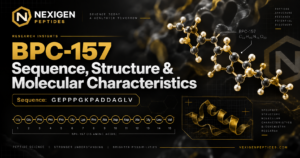
This evidence map treats BPC-157 as a synthetic 15-residue peptide studied primarily in preclinical research. The identity of the material and the model used in a paper should be established before findings are generalized.
Major Research Areas
- peptide identity and sequence
- cellular and tissue models
- animal research
- mechanistic hypotheses
What the Literature Can Establish
The published BPC-157 literature is dominated by laboratory and animal-model research rather than a large body of controlled human evidence.
Biochemical assays can support mechanism, cellular experiments can test pathway responses, animal models add organism-level complexity, and human studies answer different translational questions. Each evidence level should remain labeled.
What Remains Uncertain or Model-Dependent?
Preclinical findings do not establish clinical effectiveness, dosing, safety or consumer use, and independent replication remains important for evaluating proposed mechanisms.
Evidence-Quality Checklist
- Was the exact compound or formulation identified?
- Was the experimental model clearly described?
- Were appropriate negative, vehicle or positive controls used?
- Were the measured endpoints appropriate to the conclusion?
- Has the observation been replicated independently?
- Does the source distinguish mechanism from clinical or organism-level outcome?
Reference Pathways
Use the original paper whenever a specific finding is discussed. Database searches are starting points, not substitutes for reading the underlying study.
Continue the BPC-157 Research Cluster
View BPC-157 10 mg Research Peptide for the product-specific research-material page.
Research Peptides hub · Peptide Research Guide · Peptide Science Library