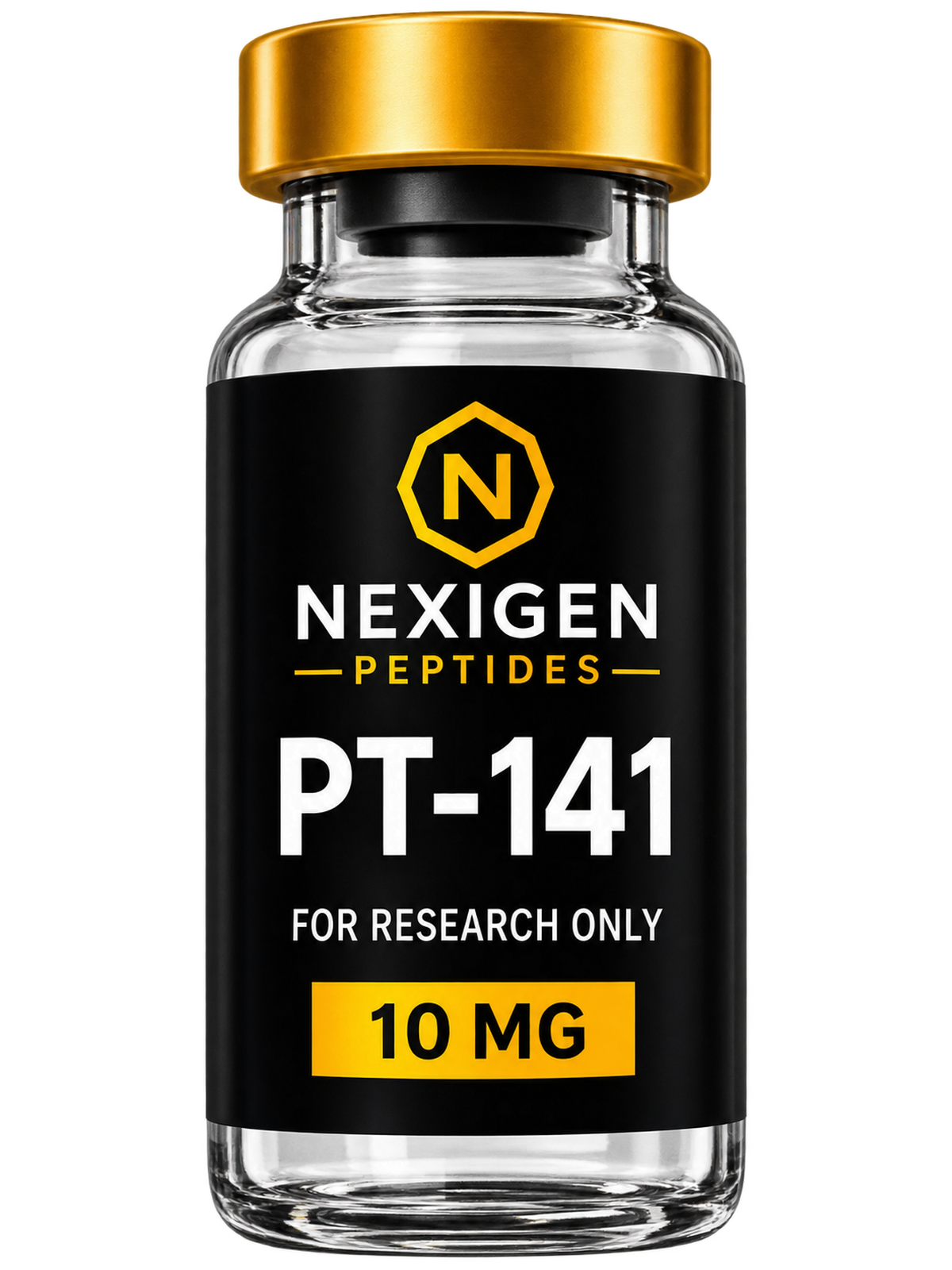
Quick answer: PT-141 10 mg Research Peptide is presented by Nexigen as a research peptide for legitimate laboratory, analytical and scientific research. This page provides product-specific research context and links to related Nexigen research resources.
Quick answer: PT-141, also known by the generic name bremelanotide, is a synthetic cyclic heptapeptide studied in melanocortin-receptor research. Nexigen PT-141 10 mg is presented solely as a laboratory research material. This page identifies the compound, summarizes molecular and receptor context, distinguishes research material from the FDA-approved prescription-drug context, and links to supporting scientific resources.
Research Peptides hub · Peptide Research Guide · Mechanism vs Outcome in Peptide Research
PT-141 10 mg Research Material — Product Overview
PT-141 is the historical research designation associated with bremelanotide, a synthetic cyclic peptide investigated in experimental work involving melanocortin receptor systems, receptor selectivity, peptide structure and downstream signaling. Nexigen supplies this 10 mg material exclusively for legitimate laboratory, analytical and scientific investigation.
The information below is intended to help researchers identify the material and interpret scientific sources accurately. Experimental or clinical findings in the literature should not be generalized to a laboratory research material without confirming exact identity, chemical form, analytical characterization and experimental context.
| Specification | Information |
|---|---|
| Research material | PT-141 / bremelanotide |
| Quantity | 10 mg |
| Compound class | Synthetic cyclic heptapeptide |
| CAS number | 189691-06-3 |
| Molecular formula | C50H68N14O10 (bremelanotide free base) |
| Molecular weight | Approximately 1025.2 g/mol |
| Sequence / structural notation | Ac-Nle-cyclo(Asp-His-D-Phe-Arg-Trp-Lys-OH) |
| Physical form | Lyophilized research material |
| Intended use | Laboratory research only |
What Is PT-141?
PT-141 is the developmental research code historically used for bremelanotide. PubChem identifies bremelanotide as a seven-amino-acid cyclic peptide with the molecular formula C50H68N14O10, molecular weight of approximately 1025.2 g/mol and CAS number 189691-06-3. The cyclic architecture includes a lactam bridge and incorporates norleucine and D-phenylalanine residues.
In research literature, PT-141 is discussed in connection with melanocortin receptor pharmacology and central melanocortin signaling. Because the compound now also has an established prescription-drug context, research pages should distinguish molecular identity and experimental literature from clinical-use claims.
PT-141 and Melanocortin Receptor Research
Current FDA labeling for bremelanotide describes it as a melanocortin receptor agonist that activates multiple melanocortin receptor subtypes. The label lists the relative order of potency as MC1R, MC4R, MC3R, MC5R and MC2R, with MC1R and MC4R described as the most relevant receptor interactions at therapeutic exposure levels. These receptor relationships are useful scientific context for laboratory studies investigating melanocortin signaling, receptor selectivity and downstream pathway behavior.
Researchers should keep mechanism and outcome separate. Demonstrating receptor binding or signaling in an experimental system does not by itself establish a clinical outcome, and observations from one model should not be extrapolated beyond the conditions of that study.
PT-141 Molecular Identity and Structure
Precise chemical identity matters when comparing peptide studies. PubChem lists bremelanotide using the condensed sequence Ac-Nle-Asp(1)-His-D-Phe-Arg-Trp-Lys(1)-OH. The cyclic structure differentiates the molecule from linear peptide analogues and can affect conformational behavior, receptor interaction and analytical characterization.
Researchers evaluating PT-141 should confirm whether a publication discusses bremelanotide free base, an acetate-associated form, a formulated prescription product or another experimental representation. Similar naming does not guarantee that two materials are analytically or experimentally interchangeable.
Prescription-Drug Context: Bremelanotide and Vyleesi
Bremelanotide is also the active ingredient in Vyleesi, an FDA-approved prescription medicine. The current FDA prescribing information is marked Rx only and was revised in October 2026. That approved-drug context concerns a specific regulated formulation, strength, route of administration, manufacturing system and clinical indication.
Nexigen PT-141 research material is not Vyleesi, is not presented as an FDA-approved drug and is not offered for clinical or personal use. References to FDA labeling on this page are included to distinguish the established prescription-drug context from laboratory research material and to help researchers interpret scientific terminology accurately.
Research Context and Evidence Interpretation
PT-141/bremelanotide appears in several evidence layers, including receptor pharmacology, preclinical experiments and human clinical research. Those evidence categories answer different questions. Receptor studies may address binding or signaling. Preclinical models may explore biological pathways under controlled experimental conditions. Clinical trials evaluate a regulated drug formulation in defined patient populations.
For this reason, researchers should identify the evidence layer before drawing conclusions. A clinical result involving an FDA-approved formulation does not establish the properties, quality or suitability of a separate laboratory research material. Likewise, a molecular mechanism should not be presented as though it automatically predicts an outcome.
Evaluating PT-141 as a Research Material
Researchers evaluating PT-141 or other peptide materials should consider more than the product name and nominal vial quantity. Relevant questions include:
- Compound identification: Is the material clearly identified using recognized chemical and peptide information?
- Lot traceability: Can available documentation be matched to the specific lot or batch?
- Analytical methodology: Which methods were used to evaluate identity, composition or purity?
- Material form: Does the documentation identify the chemical or salt form being tested?
- Evidence fit: Does the cited literature study the same material representation and experimental model?
- Research-use designation: Is the material clearly separated from human, veterinary or clinical use?
Nexigen’s objective is to make product identity and available batch information accessible so research customers can evaluate materials using documented information rather than generalized promotional claims.
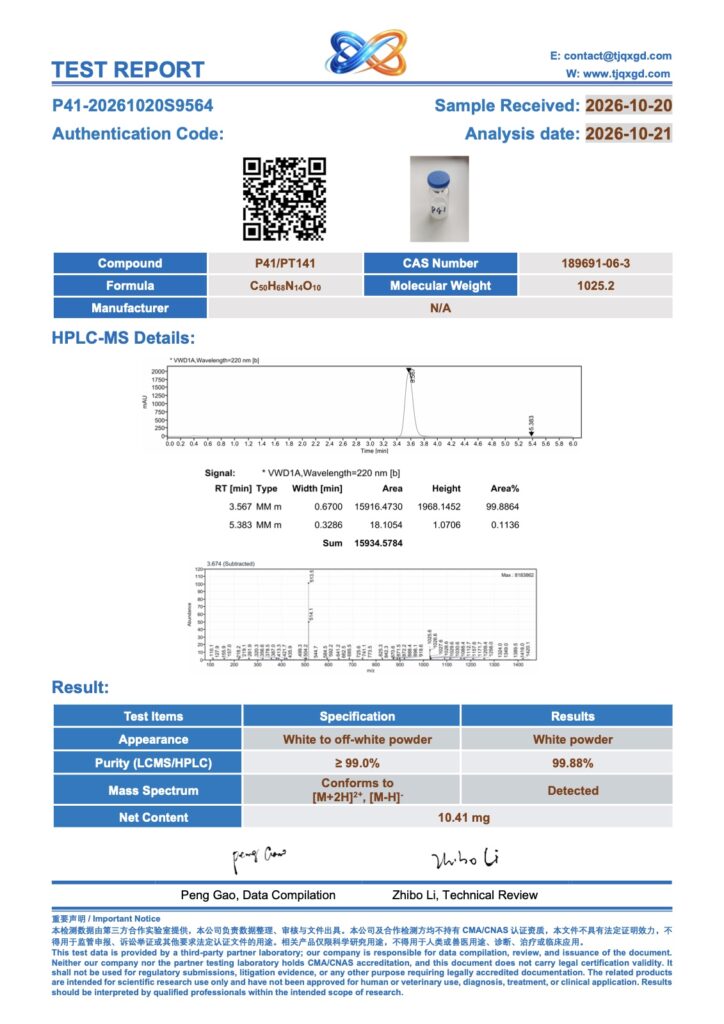
Analytical Evaluation of PT-141 Research Material
High-Performance Liquid Chromatography
HPLC may be used to separate sample components and characterize a chromatographic profile under defined analytical conditions. A reported chromatographic purity value should be interpreted according to the method and sample used.
Mass Spectrometry
Mass spectrometric methods can provide molecular information relevant to compound identity. Chromatographic separation and mass analysis answer complementary questions; one should not automatically be treated as a substitute for the other.
Orthogonal Verification
Where available, multiple analytical approaches can strengthen material characterization by examining different properties of the same sample. Researchers should review the actual lot-specific documentation rather than assuming that a company-level claim applies to every batch.
Batch Documentation
Available batch-specific analytical documentation for Nexigen research materials is published through the Batch Documentation / Certificates area when available. Analytical results apply only to the material and lot identified in the corresponding report. The absence of a current certificate on a product page should not be interpreted as a claim that a particular test has been performed.
Laboratory Handling
Handling, preparation and storage requirements depend on the material form, analytical method and research protocol. Laboratory personnel should follow validated procedures, applicable safety practices and lot-specific documentation where available. Nexigen does not provide human or veterinary preparation, dosing, injection or administration instructions.
PT-141 Research Resources
- PubChem: Bremelanotide compound record
- FDA: Current Vyleesi (bremelanotide) prescribing information
- PubMed search: Bremelanotide research
- Nexigen Research Peptides hub
- Mechanism vs Outcome in Peptide Research
PT-141 Research Peptide FAQ
What is PT-141?
PT-141 is the historical research designation associated with bremelanotide, a synthetic cyclic heptapeptide studied in melanocortin receptor research.
Is PT-141 the same compound as bremelanotide?
PT-141 is widely used as the developmental research designation for bremelanotide. Researchers should still verify the exact chemical form and material documentation used in a specific experiment.
What is the molecular weight of bremelanotide?
PubChem lists a molecular weight of approximately 1025.2 g/mol for bremelanotide free base.
Which receptor system is associated with PT-141 research?
Bremelanotide is studied as a melanocortin receptor agonist. FDA labeling describes activity across several melanocortin receptor subtypes, with MC1R and MC4R particularly relevant in the approved-drug pharmacology context.
Is bremelanotide an FDA-approved prescription-drug ingredient?
Yes. Bremelanotide is the active ingredient in the FDA-approved prescription medicine Vyleesi. Nexigen PT-141 research material is not the branded prescription product and is not offered for clinical use.
Does Nexigen provide PT-141 dosing or administration instructions?
No. Nexigen does not provide human or veterinary dosing recommendations, injection instructions, administration guidance, treatment protocols or personal-use advice.
Research Use Only
Nexigen PT-141 10 mg is supplied exclusively for legitimate laboratory, analytical and scientific research. It is not intended for human or veterinary use or consumption, diagnosis, treatment, mitigation, cure, prevention or other medical application. Scientific and regulatory references are provided for research context and do not constitute medical advice or a representation of clinical suitability.
PT-141 Research at a Glance
Quick Answer
PT-141 10 mg Research Peptide is presented by Nexigen as a research peptide for legitimate laboratory, analytical and scientific research.
Key Facts
- Research material: PT-141
- Page type: Product-specific research material page
- Related research resources: 0
- Aliases/search terms: pt 141
Evidence Interpretation
Research findings linked from this page may come from biochemical, cellular, animal or human studies depending on the compound. Those evidence levels answer different questions and should not be treated as interchangeable.
What This Page Does Not Establish
This page does not establish human or veterinary safety, efficacy, dosing, administration or a clinical indication. Nexigen does not provide personal-use guidance.